



Bridging In Dubai Climate: Materials And Construction
Thermal bridges are a primary cause of elevated cooling loads, condensation, mould risk and occupant discomfort in Dubai and the Gulf. This article explores Materials and Construction Details That Prevent Thermal Bridging in Dubai Climate with practical, region-specific materials, detailing strategies, inspection methods and post‑remediation verification for architects, engineers and facility managers in the UAE and nearby Saudi cities.
Dubai’s hot, often humid climate combined with heavy air‑conditioning use means thermal bridging produces dew‑point conditions on internal surfaces during long cooling seasons; therefore, correct materials and construction details are essential to protect building durability, reduce HVAC energy use and prevent health risks from mould and corrosion. This relates directly to Materials And Construction Details That Prevent Thermal Bridging In Dubai Climate.
Understanding Materials and Construction Details That Prevent Thermal Bridging in Dubai Climate
Thermal bridging occurs where a more conductive element penetrates or bypasses the thermal envelope, creating a local path for heat flow and causing surface temperature drops or rises that can trigger condensation. Selecting appropriate Materials and Construction Details That Prevent Thermal Bridging in Dubai Climate requires combining low‑conductivity materials, continuous insulation and thermally broken connections adapted to desert humidity and solar loads.
Materials And Construction Details That Prevent Thermal Bridging In Dubai Climate – Why Thermal Bridges Matter in Dubai and the Gulf
In Dubai’s climate, cooling dominates energy use year‑round; thermal bridges increase cooling loads, create cold surface spots during air‑conditioning operation and encourage moisture accumulation and mould growth—problems amplified where relative humidity ranges 60–90% in summer and buildings are sealed tightly while cooled to 22–24°C.
Beyond energy, thermal bridges can cause local corrosion (rebar in slabs), deterioration of finishes and repeated maintenance costs—issues that in villas or high‑end projects can mean repairs costing tens of thousands of AED if left unchecked. When considering Materials And Construction Details That Prevent Thermal Bridging In Dubai Climate, this becomes clear.
10 Materials and Construction Details That Prevent Thermal Bridging in Dubai Climate
Below are proven materials and detailing practices tailored for Dubai climate that significantly reduce thermal bridging.
1. Structural Thermal Breaks (High‑performance composite pads)
Insert engineered thermal break materials at slab‑to‑wall, parapet and balcony connections to interrupt conductive concrete paths. Materials include glass‑fibre reinforced polymers (GFRP), phenolic resin spacers and proprietary composite pads with low lambda values; these reduce heat flow through concrete elements and are durable in UAE heat and sun exposure. The importance of Materials And Construction Details That Prevent Thermal Bridging In Dubai Climate is evident here.
2. Continuous External Thermal Insulation (ETICS / External Insulation)
Continuous external insulation over the envelope avoids interrupted insulation at studs or blockwork and moves thermal mass inside the insulated layer—this reduces internal surface dew points and lowers cooling loads. Typical systems use mineral wool, polyisocyanurate (PIR) boards or high‑density EPS with appropriate weatherproof finishes for UV and sand abrasion resistance.
3. Thermally Broken Window Frames and Curtain‑wall Profiles
Specify aluminium frames with polyamide thermal break sections or thermally broken stainless profiles for windows and curtain walls. Fully thermally broken frames maintain internal surface temperatures closer to indoor setpoints and must be paired with low‑E, solar‑control glazing to minimise solar gains common in Dubai’s façade loads. Understanding Materials And Construction Details That Prevent Thermal Bridging In Dubai Climate helps with this aspect.
4. Insulated Slab Edge and Balcony Design
Avoid uninsulated cantilever slabs; instead use recessed slab details, thermal‑break connectors or ensure slab edges are insulated with rigid insulation and protected by waterproofing. Consider using balcony decking solutions that incorporate thermal breaks to prevent slab conduction into interior spaces.
5. Cavity and Double‑skin Façade Systems
Double‑skin façades or ventilated rainscreen systems add a buffer zone that reduces direct conduction and solar overheating of inner walls. When properly detailed, cavities reduce thermal bridging at wall junctions and provide opportunities for solar shading integrated in the gap. Materials And Construction Details That Prevent Thermal Bridging In Dubai Climate factors into this consideration.
6. High‑performance Insulation Materials with Low Thermal Conductivity
Use PIR, phenolic foam, vacuum insulated panels (where budget allows) and closed‑cell spray polyurethane foam (SPF) applied continuously. Choose products rated for high ambient temperatures and UV exposure, and ensure compressive strength where used at slab edges.
7. Thermal Break Connectors for Metal and Structural Penetrations
For steel connections, curtain‑wall anchors and balcony tie‑backs, use thermal break fasteners or insulated anchors that interrupt the conductive metal path with polymer spacers or capped insulation washers. This relates directly to Materials And Construction Details That Prevent Thermal Bridging In Dubai Climate.
8. Warm Roof Assemblies with Vapour Management
In Dubai, roof assemblies with insulation above the deck (warm roof) reduce heat transfer into conditioned spaces and minimise interstitial condensation when combined with vapour‑open membranes to allow drying. Use UV‑resistant membranes and protect insulation from sand ingress.
9. Airtightness and Service Penetration Sealing
Air leakage carries latent heat and moisture; sealing service penetrations with flexible, durable gaskets or tapes prevents moist air reaching cold surfaces and causing condensation at thermal bridges. Airtightness is complementary to thermal continuity. When considering Materials And Construction Details That Prevent Thermal Bridging In Dubai Climate, this becomes clear.
10. Material Compatibility and Corrosion‑resistant Details
Choose materials compatible in salt‑laden coastal environments (stainless fixings, corrosion‑protected rebars) and avoid detail assemblies where galvanic corrosion can reduce performance and create unintended conductive paths over time.
Designing Junctions and Penetrations to Prevent Thermal Bridges
Details matter: the greatest risk points are slab edges, balconies, window reveals, parapets, service penetrations, column‑to‑wall junctions and internal partition terminations. Designing these junctions with the primary keyword in mind reduces risk: The importance of Materials And Construction Details That Prevent Thermal Bridging In Dubai Climate is evident here.
- Use continuous insulation across junctions; extend external insulation past interfaces and tape or seal joints to maintain continuity.
- Design window reveals with insulated reveal liners or jamb insulation blocks to avoid cold spots at frames.
- Penetrations: specify insulated sleeve assemblies or thermal collars for ducts, pipes and anchors.
Documenting these junctions in tender drawings and performing on‑site inspection during rough construction prevents common field errors that break the insulation plane.
Thermal Bridging Calculation Methods for Architects and Engineers
Quantifying thermal bridges allows designers to compare options and comply with energy standards. Common methods include:
- Linear thermal transmittance (Psi‑value) calculation using EN ISO 10211 detailed 2D heat flow models; compute linear heat loss (W/m·K) for junctions and multiply by length for whole‑building energy accounting.
- 3D finite element modelling for complex junctions where out‑of‑plane flows and multiple materials interact.
- Use simplified tabulated Psi values from standards or assessed details when time or budget limits detailed modelling, then adjust with conservative factors for UAE climate.
Architects in Dubai should simulate summer peak cooling conditions and indoor setpoints (e.g., 24°C) with external temperatures representative of design (40–45°C daytime) and include solar loads; hygrothermal modelling (WUFI or similar) helps predict dew‑point locations and mould risk for assemblies under Gulf humidity and reverse vapour drive scenarios common in air‑conditioned buildings.[2]
How to Perform Infrared Thermal Imaging for Hidden Thermal Bridges
Infrared thermography is an effective field method to locate hidden thermal bridges and validate repairs when performed under correct boundary conditions. Understanding Materials And Construction Details That Prevent Thermal Bridging In Dubai Climate helps with this aspect.
Best practice for Dubai inspections
- Conduct surveys during steady‑state conditions — ideally early morning before solar heating or during prolonged AC operation so indoor/outdoor delta-T is sufficient (target ≥10–15°C).
- Record ambient, surface and RH values; high humidity can reduce thermal contrast and cause false positives, so note dew point and avoid imaging during fog or rain.
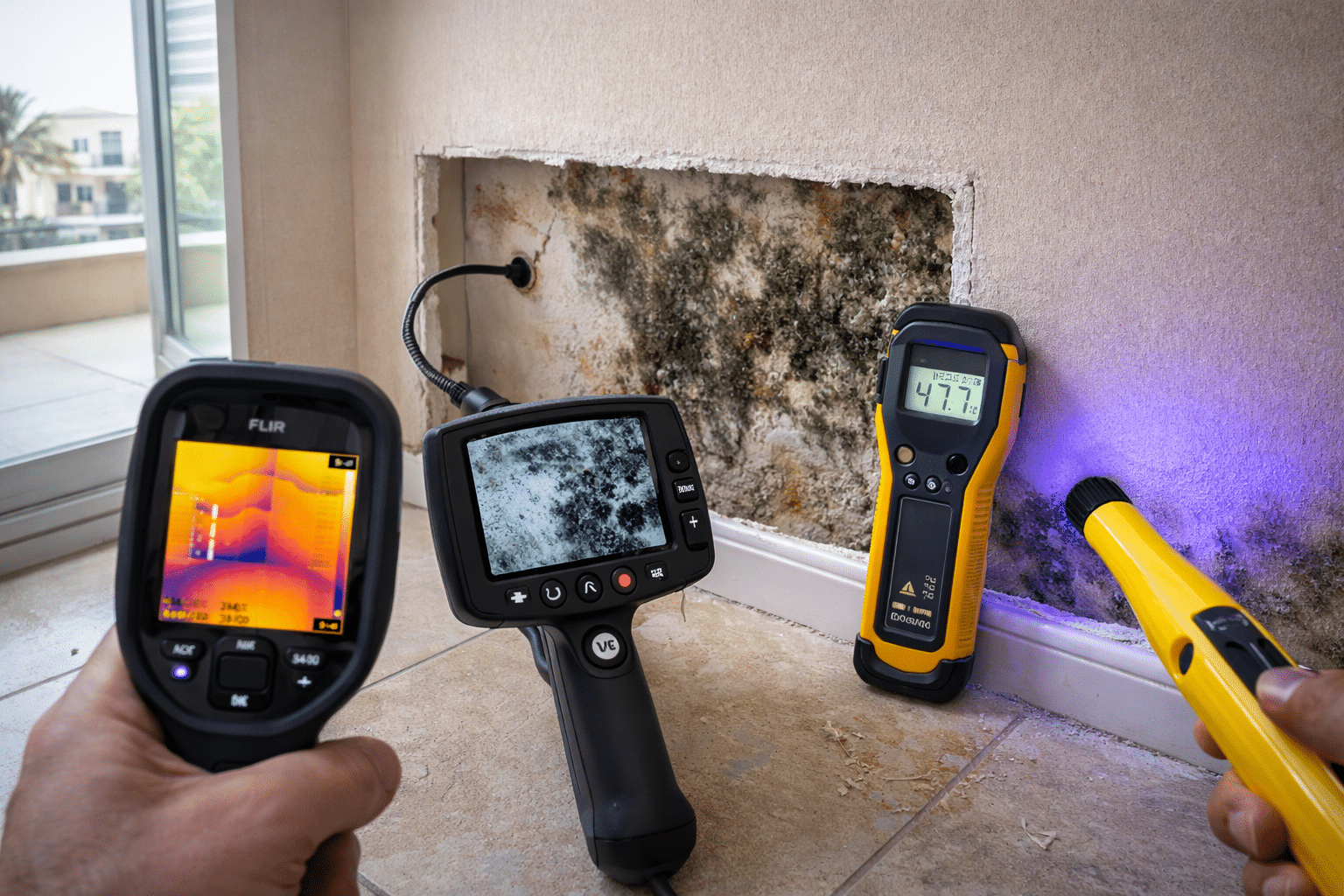
- Combine thermal imaging with moisture meters and borescope inspection for concealed cavities to confirm actual moisture or conductive elements behind cold spots.
- Use high‑resolution cameras and create annotated reports with temperature scales, emissivity settings and reference thermistors for accuracy.
Post-Remediation Verification: Measuring Success After Thermal Bridge Repairs
After remediation, verification confirms that thermal continuity and hygrothermal risk have been addressed. Steps include:
- Repeat infrared thermography under comparable boundary conditions and compare pre/post thermal maps to verify elimination of cold spots.
- Measure indoor relative humidity and surface temperatures at previously affected locations; ensure surface temperature remains above dew point at design indoor conditions.
- For high‑risk areas, perform hygrothermal monitoring (temperature and RH loggers) over several weeks to capture transient conditions and prove no interstitial condensation occurs.
- Document air leakage improvements with blower door testing where practical; reductions in leakage correlate with reduced latent heat transfer and improved condensation resistance.
UAE Regulatory & Local Considerations
Designers should align details with local green building frameworks and client expectations:
- Abu Dhabi’s Estidama Pearl rating and Dubai codes emphasise moisture control and thermal performance—hygrothermal assessments are increasingly referenced for high‑performance projects.[2]
- Material selection must account for UV exposure, sand abrasion and coastal salt; specify appropriate coatings and stainless fixings for long service life.
- Consider local contractor skills: invest in clear shop drawings and on‑site mockups for complex thermal break details to prevent field installation errors, a common cause of broken insulation continuity.
- Budgeting: retrofits can be costly (external insulation and balcony remediation often cost tens of thousands AED for villas), but lifecycle savings in cooling and repair avoidance typically recover investment in years depending on project scale.[6]
Expert Tips and Key Takeaways
- Begin with design: the most cost‑effective prevention of thermal bridging is integrated detail design, not after‑the‑fact fixes.
- Use continuous external insulation and thermal breaks at all structural crossings—these are the most reliable approach for Dubai’s cooling‑dominated climate.
- Specify thermally broken frames and insulated reveals for all glazing; glazing and frames are major thermal weak points in Gulf façades.
- Verify in the field: combine infrared thermography, moisture probing and hygrothermal modelling to understand real risk and confirm repair success.
- Document details in tender drawings and carry out site inspections during rough works to ensure insulation continuity—most failures occur from poor installation, not product selection.
Conclusion
Preventing thermal bridges in Dubai requires deliberate selection of Materials and Construction Details That Prevent Thermal Bridging in Dubai Climate, careful junction design, robust specification of thermally broken elements and verification through calculation and infrared inspection. By prioritising continuous insulation, thermal breaks at structural penetrations, thermally broken frames and airtight construction adapted for UAE conditions, designers and facility managers can reduce cooling energy use, avoid condensation and mould problems and extend building durability in the Gulf climate.
For deeper technical guidance, consider referenced authoritative resources and perform project‑specific hygrothermal modelling to capture Dubai’s high temperature and humidity interactions accurately. Understanding Materials And Construction Details That Prevent Thermal Bridging In Dubai Climate is key to success in this area.

JV de Castro, IAC2
JV de Castro is the Chief Technology Officer at Saniservice, where he leads innovation in indoor environmental sciences, IT infrastructure, and digital transformation. With over 20 years of experience spanning architecture, building science, technology management, digital media architecture, and consultancy, he has helped organizations optimize operations through smart solutions and forward-thinking strategies. JV holds a Degree in Architecture, a Masters of Research in Anthropology, an MBA in Digital Communication & Media, along with certifications in mold, building sciences and advanced networking. Passionate about combining technology, health, and sustainability, he continues to drive initiatives that bridge science, IT, and business impact.



Leave a Reply