


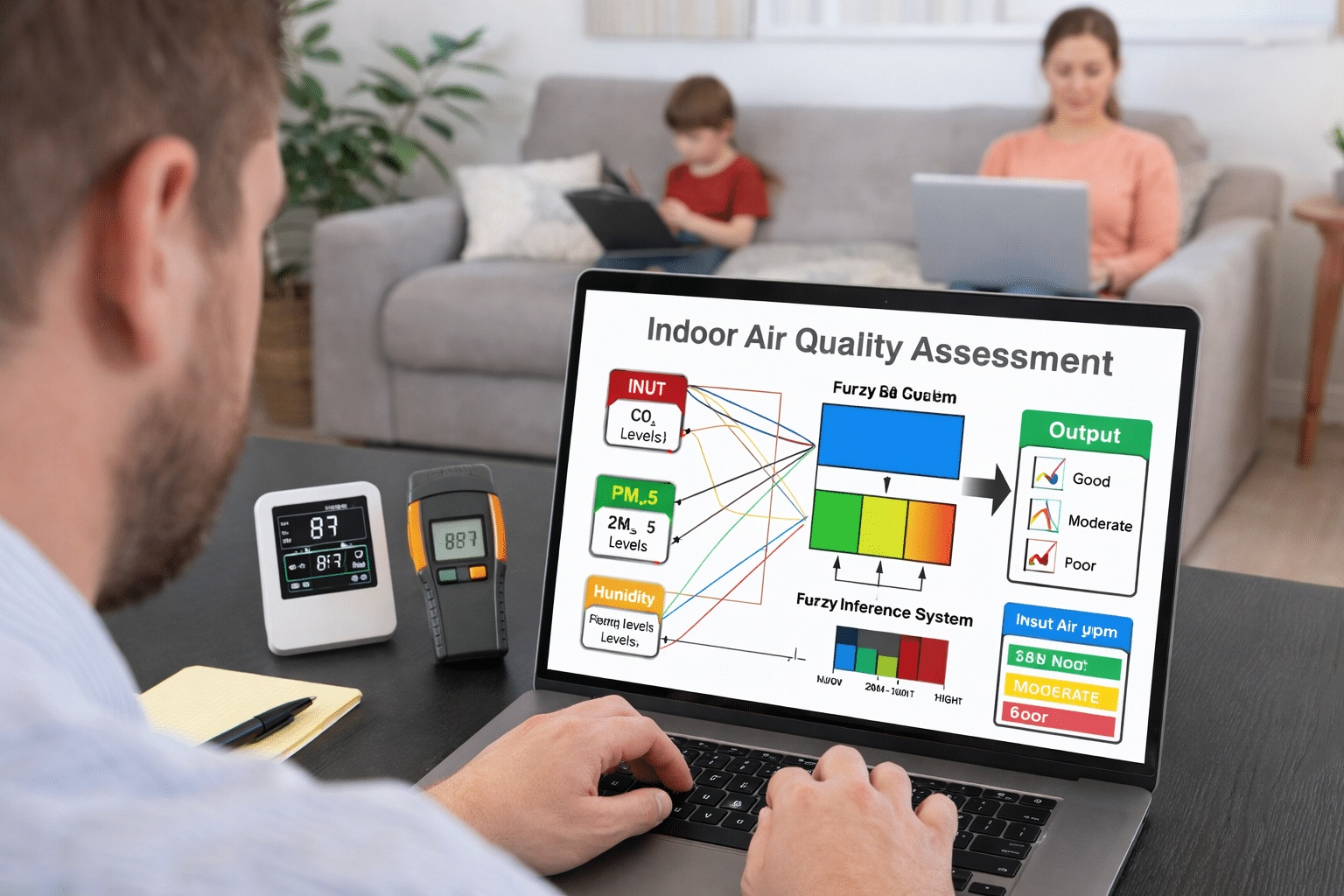
Environment Indoor Air Quality Assessment Using Fuzzy Inference
Traditional indoor air quality assessment methods have limitations in Dubai’s complex environments. Advanced assessment using fuzzy inference provides more accurate evaluations by considering multiple variables simultaneously. This expert guide reveals 7 advanced methods for indoor air quality assessment using fuzzy inference in Dubai properties.
Table of Contents
- Introduction to Fuzzy Inference
- What is Fuzzy Inference
- Environment Indoor Air Quality Assessment
- Fuzzy Set Theory
- Fuzzy Rule-Based Systems
- Application to IAQ Assessment
- Benefits and Challenges
- Expert Tips for Improving IAQ
- Frequently Asked Questions
- Conclusion on Fuzzy Assessment
Introduction to Fuzzy Inference
The environment indoors, whether it’s your Dubai home or office, has a profound impact on the health of its occupants. Indoor air quality (IAQ) is often overlooked but can lead to serious health issues such as respiratory problems and allergies. Traditional methods have limitations; this guide will introduce you to advanced assessment using fuzzy inference, which provides a more accurate evaluation by considering multiple variables simultaneously.
What is Fuzzy Inference
Fuzzy inference is a method used in artificial intelligence and computer science to handle uncertainty and vagueness in data for assessment using fuzzy inference. It is based on the concept of fuzzy sets, which allow for degrees of membership rather than strict yes/no categorizations. This makes it particularly useful in complex systems like IAQ assessment in Dubai where multiple factors interact.
Environment Indoor Air Quality Assessment
Indoor air quality assessment using fuzzy inference involves measuring and evaluating the air quality inside Dubai buildings, including pollutants such as particulate matter (PM2.5), volatile organic compounds (VOCs), carbon dioxide (CO2), temperature, humidity, and microbial content. Traditional methods often rely on discrete measurements and may miss subtle changes or interactions between variables.
Fuzzy Set Theory
Fuzzy set theory deals with the concept of partial truth where the data is not just true (1) or false (0), but can be a degree in between for assessment using fuzzy inference. This is represented by membership functions, which quantify how much an element belongs to a particular fuzzy set.
Membership Functions
For IAQ assessment using fuzzy inference, common membership functions in Dubai include:
- High CO2: A function that assigns high values when CO2 levels are above a certain threshold.
- Low Humidity: A function that assigns low values when humidity is below the comfort range.
- Particulate Matter: A function that assigns high values to higher PM2.5 concentrations.
Fuzzification
Fuzzification is the process of converting crisp input data into fuzzy sets for assessment using fuzzy inference. For example, a CO2 level of 1000 ppm might be fuzzified as “High CO2” with a membership value of 0.8 in Dubai properties.
Defuzzification
Defuzzification is the process of converting fuzzy output back into crisp values, providing actionable insights for assessment using fuzzy inference. For instance, if the system determines that a Dubai area has “High CO2” and “Low Humidity,” it might recommend increasing ventilation to reduce CO2 levels.
Fuzzy Rule-Based Systems
A fuzzy rule-based system (FRBS) consists of a set of if-then rules that define the relationships between input and output variables for assessment using fuzzy inference. For example:
If CO2 is High AND Humidity is Low THEN Ventilation Should Increase.
These rules are based on expert knowledge or data-driven models, making the system flexible and adaptable to different Dubai environments.
Rule Base
The rule base contains a set of fuzzy if-then rules for assessment using fuzzy inference. For example:
- If CO2 is High AND Humidity is Low THEN Ventilation Should Increase.
- If PM2.5 is High THEN Air Filtration Should Increase.
- If Temperature is High AND Humidity is Low THEN Dehumidification Required.
Inference Engine
The inference engine applies the rules to the fuzzified inputs and produces a fuzzy output for assessment using fuzzy inference. This process involves:
- Aggregation of Rules: Combining the effects of multiple rules.
- Implication: Determining how each rule affects the output.
Application to IAQ Assessment
Assessment using fuzzy inference can be applied in various aspects of IAQ assessment in Dubai, such as:
- Real-Time Monitoring: Continuous monitoring and adjustment based on dynamic conditions.
- Data Integration: Combining multiple data sources to provide a comprehensive view of IAQ.
- Risk Assessment: Identifying potential health risks associated with IAQ parameters.
Example Application
A real-world example involves using assessment using fuzzy inference in a Dubai office environment. Sensors measure CO2, temperature, humidity, and particulate matter. The system applies fuzzy rules to determine if ventilation should increase or decrease based on the current conditions.
Benefits and Challenges
Benefits
- Accuracy: Assessment using fuzzy inference can handle complex interactions between variables, providing more accurate assessments than traditional methods in Dubai.
- Actionable Insights: The system provides clear recommendations for improving IAQ based on real-time data.
- Flexibility: Rules can be adjusted to fit specific Dubai environments or conditions.
Challenges
- Data Quality: Assessment using fuzzy inference relies heavily on high-quality, reliable data.
- Rule Development: Creating effective fuzzy rules requires expertise and extensive testing.
- Computation Intensive: Real-time applications can be computationally demanding.
Expert Tips for Improving IAQ
To improve indoor air quality using assessment using fuzzy inference in Dubai, consider the following tips:
- Regular Monitoring: Use sensors to continuously monitor IAQ parameters in Dubai properties.
- Data Analysis: Analyze data patterns to identify trends and areas for improvement.
- Rule Optimization: Regularly review and update fuzzy rules based on new data or changing conditions.
Frequently Asked Questions
Q: How accurate is assessment using fuzzy inference in IAQ for Dubai properties?
A: Assessment using fuzzy inference provides more accurate assessments by handling complex interactions between variables in Dubai’s unique environment.
Q: Can assessment using fuzzy inference be used for real-time IAQ monitoring?
A: Yes, assessment using fuzzy inference can handle real-time data to provide continuous monitoring and adjustments in Dubai properties.
Q: How do I implement assessment using fuzzy inference in my Dubai home or office?
A: You can use smart sensors and AI systems that incorporate fuzzy logic to monitor and improve IAQ in Dubai.
Conclusion on Fuzzy Assessment
Assessment using fuzzy inference offers a powerful tool for environment indoor air quality by providing accurate, actionable insights. By integrating fuzzy logic into IAQ monitoring and management systems in Dubai, we can create healthier, more comfortable environments that enhance the well-being of occupants.

JV de Castro, IAC2
JV de Castro is the Chief Technology Officer at Saniservice, where he leads innovation in indoor environmental sciences, IT infrastructure, and digital transformation. With over 20 years of experience spanning architecture, building science, technology management, digital media architecture, and consultancy, he has helped organizations optimize operations through smart solutions and forward-thinking strategies. JV holds a Degree in Architecture, a Masters of Research in Anthropology, an MBA in Digital Communication & Media, along with certifications in mold, building sciences and advanced networking. Passionate about combining technology, health, and sustainability, he continues to drive initiatives that bridge science, IT, and business impact.



Leave a Reply