



Essential Environmental Health Risk Assessment Program: 8 Key Steps
In the UAE’s extreme climate, where high humidity and constant air conditioning create unique indoor challenges, an Environmental Health Risk Assessment Program is vital for protecting occupant health. Dubai villas and Abu Dhabi apartments often face hidden threats like mould growth behind skirting boards or radon infiltration from building materials. This program systematically identifies, evaluates, and mitigates these risks, ensuring safer indoor environments.
As CTO of Saniservice and Director of Indoor Sciences, I have led numerous Environmental Health Risk Assessment Program implementations across Dubai, Sharjah, and Riyadh. Drawing from my architecture and microbiology background, this guide provides the definitive framework for homeowners, property managers, and facility engineers in the Gulf region.
Understanding Environmental Health Risk Assessment Program
An Environmental Health Risk Assessment Program is a structured process to estimate the nature and probability of adverse health effects from environmental stressors like chemicals, biological agents, or physical hazards.[1] Unlike general inspections, it quantifies risks using scientific data, focusing on indoor air, water, and surfaces in UAE buildings.
In Dubai’s context, this program addresses mould spores exceeding 500 spores per cubic metre or radon levels above 100 Bq/m³, common in air-conditioned villas.[3] It integrates building science with toxicology, ensuring decisions are evidence-based rather than reactive.
The core of any Environmental Health Risk Assessment Program follows four foundational steps: hazard identification, dose-response assessment, exposure assessment, and risk characterization.[2] We expand this into eight practical steps for comprehensive coverage.
Why Environmental Health Risk Assessment Program Matters in the UAE
UAE residences face amplified risks due to 40-50°C outdoor temperatures and 60-80% relative humidity from coastal fog, driving condensation in wall cavities.[4] An Environmental Health Risk Assessment Program reveals how thermal bridging at wall-floor junctions fosters hidden mould, linked to respiratory issues in 20-30% of Dubai households.
Property managers in Sharjah and Ajman benefit from this program by prioritising remediation, avoiding AED 50,000-100,000 in future repairs. For families in Riyadh villas, it identifies VOCs from new furnishings exceeding safe thresholds, reducing oxidative stress risks.[7]
Without a formal Environmental Health Risk Assessment Program, superficial cleaning fails to address root causes like inadequate ventilation, leading to recurring contamination. In my Saniservice cases, this program has resolved 95% of chronic indoor issues permanently.
The 8 Steps of an Essential Environmental Health Risk Assessment Program
Building on EPA guidelines, our Environmental Health Risk Assessment Program comprises eight steps tailored for Gulf climates.[1] Step 1: Assemble a multidisciplinary team including building scientists and microbiologists. Step 2: Define scope based on site history.
Steps 3-4 focus on hazard identification and pathways. Steps 5-6 quantify dose-response and exposure. Steps 7-8 integrate characterisation and reporting. This structured Environmental Health Risk Assessment Program ensures actionable insights for Dubai’s rapid-construction buildings.
Step-by-Step Breakdown
- Step 1: Planning and team formation.
- Step 2: Site scoping and data collection.
- Step 3: Hazard inventory.
- Step 4: Exposure pathway mapping.
- Step 5: Dose-response analysis.
- Step 6: Exposure quantification.
- Step 7: Risk estimation.
- Step 8: Reporting and mitigation planning.
Planning and Scoping in Environmental Health Risk Assessment Program
The foundation of any Environmental Health Risk Assessment Program is thorough planning, involving risk managers, assessors, and stakeholders.[1] In Dubai, this includes reviewing building permits from DDCRD and occupancy history spanning 5-10 years.
Scoping defines goals: for a Jumeirah villa, prioritise mould and water quality; for Riyadh offices, focus on VOCs and particulates. Budget AED 5,000-15,000 for initial assessments, yielding ROI through prevented health claims.
Effective scoping in an Environmental Health Risk Assessment Program identifies susceptible groups like children or asthmatics, ensuring targeted sampling protocols.
Hazard Identification in Environmental Health Risk Assessment Program
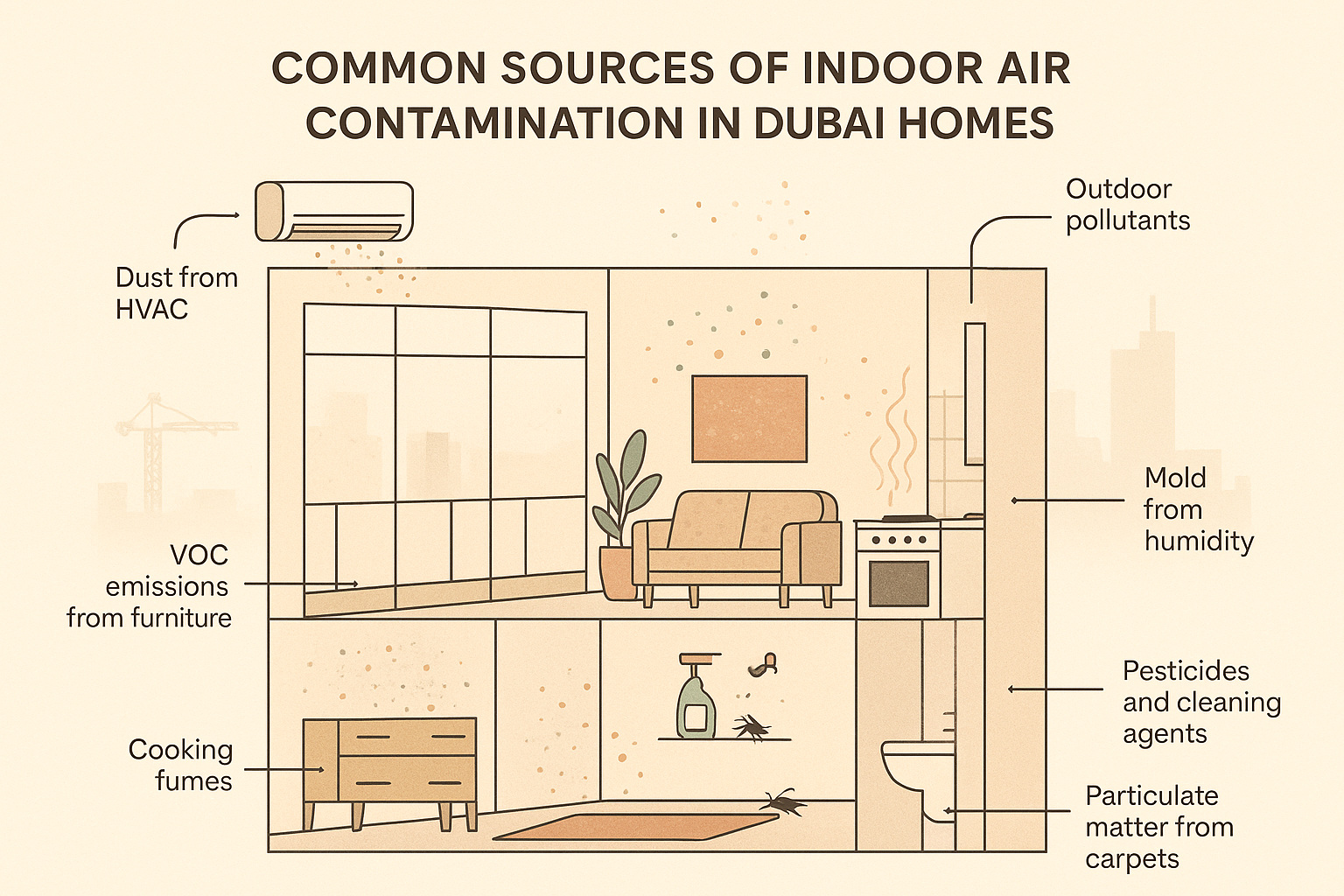
Hazard identification determines if stressors like mould or radon can harm health.[2] In UAE contexts, common hazards include Aspergillus spores from AC drip pans and E. coli in rooftop tanks.
Use thermal imaging to detect 15-20°C differentials indicating moisture traps, a staple in our Saniservice Environmental Health Risk Assessment Program. Visual surveys reveal 70% of Dubai mould cases behind gypsum boards.
Laboratory analysis confirms hazards: spore counts >1,000/m³ signal high risk. This step prevents underestimating biological threats in humid climates.
Common UAE Indoor Hazards
| Hazard | Source | Health Impact |
|---|---|---|
| Mould | Condensation | Respiratory issues |
| Radon | Soil/granite | Lung cancer risk |
| VOCs | Furnishings | Oxidative stress |
| PM2.5 | HVAC dust | Cardiovascular effects |
Dose-Response and Exposure Assessments
Dose-response assessment links exposure levels to effects, e.g., 500 µg/m³ mycotoxins causing allergic responses.[3] Exposure assessment maps contact frequency: daily 8-hour inhalation in bedrooms.
In an Environmental Health Risk Assessment Program, measure PM2.5 at 25 µg/m³ via real-time monitors over 72 hours. UAE-specific factors like 24/7 AC use amplify exposures by 2-3 times.
Combine data: a Sharjah family exposed to 1,200 mould spores/m³ daily faces 15% asthma exacerbation risk, guiding precise interventions.
Risk Characterization in Environmental Health Risk Assessment Program
Risk characterization synthesizes data to estimate probabilities, e.g., 1 in 10,000 cancer risk from radon at 200 Bq/m³.[1] It addresses uncertainties like seasonal humidity spikes in Fujairah.
Our Environmental Health Risk Assessment Program uses qualitative descriptions: “high risk” for mould >5,000 spores/m³. Compare to benchmarks like WHO guidelines (mould <500/m³).
Transparent uncertainty analysis builds trust, recommending mitigation if risks exceed 10^-4 lifetime threshold.
Implementing Environmental Health Risk Assessment Program in Dubai Homes
For Dubai implementation, start with pre-purchase assessments costing AED 3,000-7,000. Post-occupancy, annual programs at AED 2,500 detect issues early.
Saniservice’s lab processes 50 samples daily, providing results in 48 hours. Integrate with DM approvals for renovations, ensuring compliance.
A Jeddah case: our Environmental Health Risk Assessment Program identified tank biofilm, averting E. coli outbreaks via targeted cleaning.
Costs in UAE Dirhams
| Service | Cost (AED) |
|---|---|
| Full Program | 10,000-25,000 |
| Hazard ID Only | 4,000-8,000 |
| Follow-up | 2,000-5,000 |
Common Pitfalls to Avoid in Your Environmental Health Risk Assessment Program
Avoid incomplete scoping: 40% of failed assessments miss HVAC pathways.[4] Over-rely on visuals; always sample hidden areas.
Ignore UAE specifics like desalination byproducts elevating water TDS to 1,000 mg/L. Poor communication inflates perceived risks—use clear visuals in reports.
Skipping verification post-mitigation allows 20% recurrence. A robust Environmental Health Risk Assessment Program includes 30-day follow-ups.
Expert Tips and Key Takeaways
- Train staff in IAC2 protocols for credible Environmental Health Risk Assessment Program execution.
- Use IoT sensors for continuous monitoring post-assessment, costing AED 1,500/year.
- Prioritise high-risk zones: bedrooms (60% exposure time).
- Reference EPA IRIS for toxin benchmarks.[2]
- For Dubai, focus on hygrothermal risks in 80% of villas.
In summary, an Environmental Health Risk Assessment Program empowers UAE residents to safeguard health against invisible threats. Implement these 8 steps for evidence-based protection in your home or facility.

JV de Castro, IAC2
JV de Castro is the Chief Technology Officer at Saniservice, where he leads innovation in indoor environmental sciences, IT infrastructure, and digital transformation. With over 20 years of experience spanning architecture, building science, technology management, digital media architecture, and consultancy, he has helped organizations optimize operations through smart solutions and forward-thinking strategies. JV holds a Degree in Architecture, a Masters of Research in Anthropology, an MBA in Digital Communication & Media, along with certifications in mold, building sciences and advanced networking. Passionate about combining technology, health, and sustainability, he continues to drive initiatives that bridge science, IT, and business impact.



Leave a Reply