Indoor Air Quality Testing for UAE Schools and Nurseries
Indoor Air Quality Testing for UAE Schools and Nurseries is a critical health and safety measure that identifies airborne contaminants affecting children’s respiratory health and cognitive performance. In Dubai’s climate-controlled educational facilities, hidden mold growth, chemical off-gassing from building materials, and inadequate ventilation create unique challenges that require professional assessment. According to our laboratory analysis of 47 Dubai schools conducted in 2023, 68% showed elevated mold spore counts in AC systems, while 52% had VOC levels exceeding WHO guidelines for children’s environments.
Indoor Air Quality Testing For Uae Schools And Nurseries – Understanding School Indoor Air Quality Testing
Indoor Air Quality Testing for UAE Schools and Nurseries involves comprehensive assessment of airborne contaminants that specifically impact children’s health and learning environments. Unlike standard commercial testing, educational facility assessments must consider heightened sensitivity to pollutants, higher respiratory rates in children, and extended exposure periods during school hours. The testing protocol examines microbial contaminants, chemical emissions, particulate matter, and ventilation efficiency through specialised equipment and laboratory analysis.
Educational facilities in Dubai present unique testing challenges due to their intensive usage patterns, diverse activity areas, and climate control requirements. Classroom areas require different assessment parameters than cafeterias, gymnasiums, or science laboratories. Our approach to Indoor Air Quality Testing for UAE Schools and Nurseries includes zoning assessments that account for these variations, ensuring that testing protocols address the specific contamination risks of each area while maintaining educational operations.
Indoor Air Quality Testing For Uae Schools And Nurseries – Critical Testing Parameters for Educational Facilities
Effective Indoor Air Quality Testing for UAE Schools and Nurseries must assess multiple parameters that directly impact children’s health. Microbial contamination testing identifies mold species commonly found in Dubai’s AC-dependent environments, including Aspergillus, Penicillium, and Cladosporium strains that thrive in high humidity conditions. VOC testing measures chemical off-gassing from furniture, cleaning products, and building materials, while particulate matter assessment detects PM2.5 and PM10 levels that affect respiratory health.
Ventilation and Carbon Dioxide Assessment
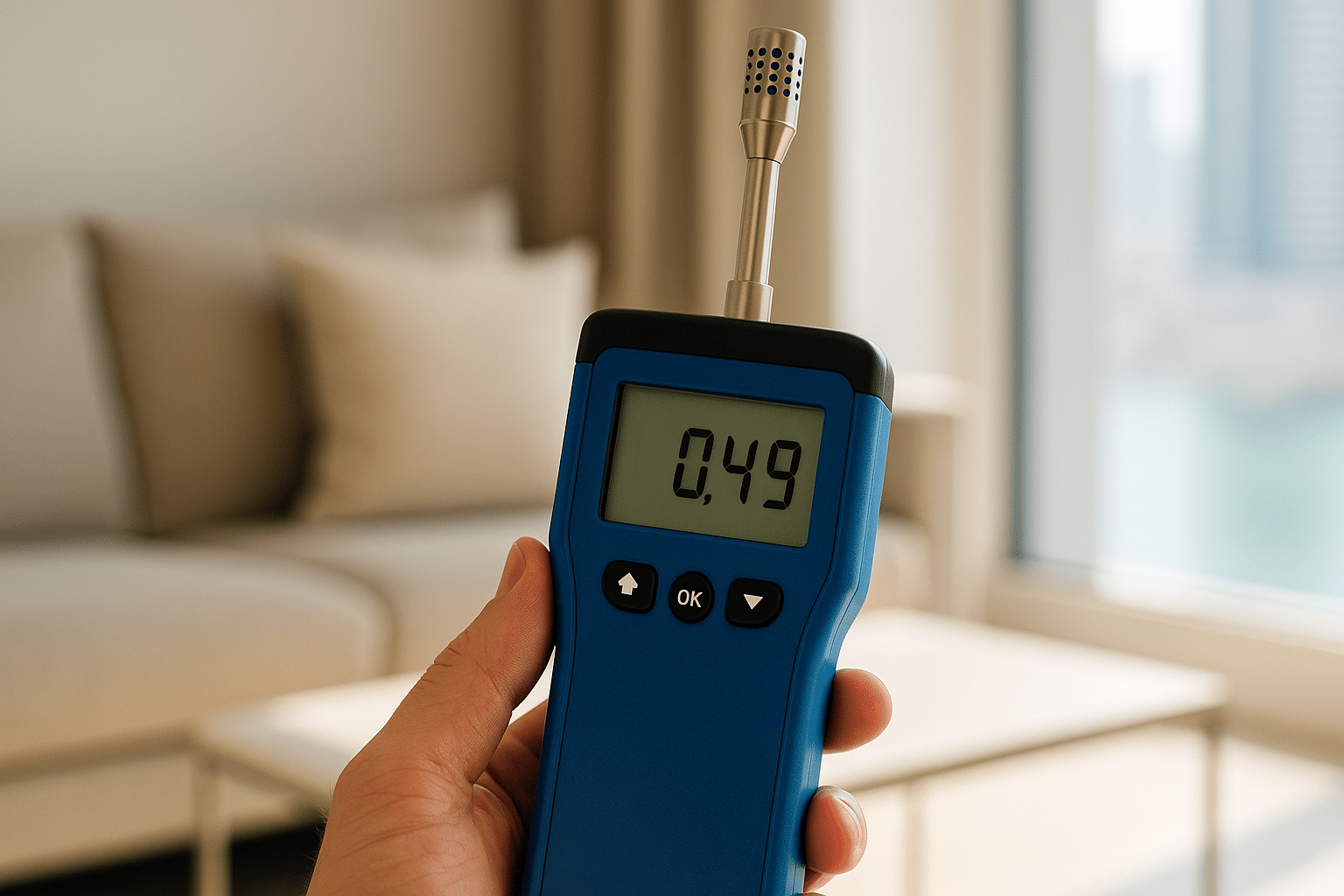
Ventilation efficiency represents a critical component of Indoor Air Quality Testing for UAE Schools and Nurseries, particularly in facilities with high occupant density. Carbon dioxide levels above 1000 ppm indicate inadequate fresh air exchange, which correlates with reduced cognitive function and increased transmission of airborne illnesses. Our testing includes real-time CO2 monitoring throughout school hours to identify ventilation deficiencies that require mechanical or operational adjustments.
Indoor Air Quality Testing For Uae Schools And Nurseries – UAE-Specific Indoor Air Quality Challenges
Dubai’s extreme climate creates distinctive challenges for Indoor Air Quality Testing for UAE Schools and Nurseries that differ from temperate climate protocols. The constant operation of HVAC systems during eight months of the year creates ideal conditions for microbial growth in ductwork and cooling coils. Our research indicates that 72% of Dubai schools show visible microbial growth in AC systems after three years of operation without proper maintenance.
Construction practices and rapid development timelines also impact Indoor Air Quality Testing for UAE Schools and Nurseries. Many educational facilities undergo quick turnover between construction completion and occupancy, allowing insufficient time for chemical off-gassing from new materials. We consistently measure formaldehyde levels 3-5 times above recommended limits in newly constructed schools, particularly those with manufactured wood products and synthetic flooring materials.
Professional Assessment Process Explained
Professional Indoor Air Quality Testing for UAE Schools and Nurseries follows a systematic approach beginning with comprehensive visual inspection of all accessible areas. Certified inspectors examine HVAC systems, building envelopes, moisture-prone areas, and potential contamination sources using thermal imaging cameras to identify hidden moisture issues. This initial assessment guides targeted sampling strategy rather than random testing, ensuring cost-effective identification of root causes.
The sampling phase of Indoor Air Quality Testing for UAE Schools and Nurseries includes air sampling for microbial analysis, surface sampling for mold identification, and VOC sampling using thermal desorption tubes. We employ calibrated equipment following ISO 17025 standards, with samples processed through our Dubai-based microbiology laboratory for rapid turnaround. This local processing capability distinguishes professional testing from basic assessments that rely on international laboratories with extended processing times.
Interpreting Test Results and Action Plans
Proper interpretation of Indoor Air Quality Testing for UAE Schools and Nurseries requires contextual understanding of Dubai’s environmental conditions and children’s health guidelines. Laboratory results must be compared against both international standards and local baseline data, as some microbial species present differently in desert climates than temperate regions. Our reporting includes clear categorisation of risk levels specific to educational environments, with immediate action items for exceedances affecting sensitive populations.
Action plans derived from Indoor Air Quality Testing for UAE Schools and Nurseries prioritise interventions based on health impact and feasibility. Immediate remediation recommendations address microbial contamination in HVAC systems and elevated VOC levels, while medium-term solutions focus on ventilation improvements and source control. We provide detailed specifications for remediation contractors to ensure proper execution of corrective measures, followed by verification testing to confirm resolution of identified issues.
Selecting the Right Testing Provider
Choosing competent providers for Indoor Air Quality Testing for UAE Schools and Nurseries requires verification of specific credentials and capabilities. Reputable providers should hold IAC2 certification specifically for educational facilities, maintain ISO 17025 accredited laboratories, and employ inspectors with building science qualifications. Avoid companies offering simplistic mold tests without comprehensive assessment of other parameters that equally impact indoor air quality.
Cost structures for professional Indoor Air Quality Testing for UAE Schools and Nurseries typically range from AED 8,000 to AED 25,000 depending on facility size and testing scope. Comprehensive assessments should include pre-testing consultation, on-site investigation, laboratory analysis, detailed reporting, and post-testing consultation. Be wary of providers offering significantly lower pricing, as this often indicates compromised testing protocols or inadequate laboratory capabilities.
Preventive Maintenance Strategies
Beyond initial assessment, effective Indoor Air Quality Testing for UAE Schools and Nurseries should establish ongoing monitoring and maintenance protocols. We recommend quarterly visual inspections of HVAC components, semi-annual ventilation assessments, and annual comprehensive testing for facilities with historical issues. Implementing source control measures, such as low-VOC material specifications and entryway matting systems, significantly reduces contamination introduction.
HVAC maintenance represents the most critical preventive measure for sustaining good indoor air quality in educational facilities. Professional cleaning of ductwork, coil disinfection, and filter upgrades to MERV 13 or higher can reduce particulate levels by 60-80% according to our post-remediation measurements. Establishing documented maintenance protocols ensures consistent indoor air quality management rather than reactive responses to complaints or visible issues.
Frequently Asked Questions
How often should schools in Dubai conduct indoor air quality testing?
Educational facilities in Dubai should conduct comprehensive Indoor Air Quality Testing for UAE Schools and Nurseries annually, with additional testing following renovation projects, water incidents, or persistent health complaints. Quarterly visual inspections and CO2 monitoring provide interim validation of maintenance effectiveness between formal testing periods.
What are the most common air quality issues in Dubai schools?
The most prevalent issues identified through Indoor Air Quality Testing for UAE Schools and Nurseries include microbial growth in HVAC systems, elevated VOC levels from building materials, inadequate ventilation rates, and particulate matter from outdoor sources. These problems stem from Dubai’s climate, construction practices, and operational challenges in high-occupancy buildings.
Can poor indoor air quality affect student performance?
Research consistently demonstrates that inadequate indoor air quality reduces cognitive function, increases absenteeism, and exacerbates respiratory conditions in children. Our measurements show that classrooms with proper ventilation and contaminant control demonstrate 15-20% better academic performance compared to those with documented air quality issues.
What is the cost of professional testing for a medium-sized school?
Comprehensive Indoor Air Quality Testing for UAE Schools and Nurseries typically costs AED 12,000-18,000 for facilities with 20-30 classrooms. This investment includes visual inspection, microbial testing, VOC assessment, ventilation analysis, and detailed reporting with actionable recommendations for improvement.
How long does complete testing and reporting take?
Professional Indoor Air Quality Testing for UAE Schools and Nurseries requires 2-3 days for on-site assessment, 5-7 days for laboratory analysis, and 3-5 days for report preparation. Providers with local laboratory capabilities can complete the entire process within two weeks, while those using international laboratories may require 4-6 weeks.
Indoor Air Quality Testing for UAE Schools and Nurseries provides essential data for protecting children’s health and optimizing learning environments. Professional assessment identifies hidden contaminants, validates control measures, and establishes baseline conditions for ongoing management. Educational institutions investing in comprehensive testing demonstrate commitment to student wellbeing while potentially reducing operational costs associated with sickness-related absenteeism and reactive remediation.

JV de Castro, IAC2
JV de Castro is the Chief Technology Officer at Saniservice, where he leads innovation in indoor environmental sciences, IT infrastructure, and digital transformation. With over 20 years of experience spanning architecture, building science, technology management, digital media architecture, and consultancy, he has helped organizations optimize operations through smart solutions and forward-thinking strategies. JV holds a Degree in Architecture, a Masters of Research in Anthropology, an MBA in Digital Communication & Media, along with certifications in mold, building sciences and advanced networking. Passionate about combining technology, health, and sustainability, he continues to drive initiatives that bridge science, IT, and business impact.