Identify Mold Growth in Your Dubai Property
How to identify mold growth in your Dubai property begins with understanding the unique environmental conditions that favour microbial development in our region. Dubai’s combination of high outdoor humidity during summer months and air-conditioned interiors creates perfect conditions for condensation and hidden moisture issues. The process involves systematic visual inspection, odour detection, health symptom monitoring and sometimes professional laboratory analysis to confirm suspected growth.
As an IAC2 Certified Indoor Air Consultant with over twelve years of field experience in Dubai properties, I’ve documented consistent patterns in how mold manifests in our climate. Unlike temperate regions where mold growth follows seasonal patterns, Dubai’s AC-dependent buildings create year-round microclimates that require specific identification approaches. This guide will walk you through the step-by-step process homeowners can use to accurately identify mold growth in their properties. This relates directly to Identify Mold Growth in Your Dubai Property.
Identify Mold Growth in Your Dubai Property – Understanding Dubai’s Unique Mold Growth Conditions
How to Identify mold growth in your Dubai property must begin with recognising why our buildings are particularly vulnerable. The extreme temperature differential between Dubai’s 45°C summer exteriors and 22°C air-conditioned interiors creates substantial condensation potential. This moisture accumulation occurs within wall cavities, behind furniture placed against exterior walls, and within HVAC systems where temperature differentials are most pronounced.
Building construction methods also contribute to mold vulnerability. Many Dubai properties feature concrete construction with minimal vapour barriers, allowing moisture migration through walls. The rapid construction timeline of many developments sometimes means insufficient drying time for building materials before enclosure, trapping construction moisture that later manifests as microbial growth. Understanding these climate-specific and construction-related factors is essential for effective mold identification.
Common Problem Areas in Dubai Properties
Through hundreds of property assessments, we’ve identified consistent problem zones across Dubai villas and apartments. Bathrooms without adequate exhaust ventilation accumulate moisture behind tiles and under sinks. Kitchens with poor extraction develop condensation around windows and cabinetry. AC drain pans with inadequate slope or blocked drains create standing water that becomes microbial breeding grounds. These areas should receive particular attention during your mold identification process.
Identify Mold Growth in Your Dubai Property – Visual Inspection Techniques for Mold Identification
How to identify mold growth in your Dubai property through visual inspection requires methodical examination of both obvious and concealed spaces. Begin with areas experiencing water exposure: around sinks, toilets, showers and bathtubs. Look for discolouration, staining or textured growth on surfaces. In Dubai properties, pay special attention to areas where exterior walls meet interior spaces, as these thermal bridges often develop condensation-related mold growth.
Use a bright torch to examine less visible areas: behind furniture placed against exterior walls, inside closets on outside walls, and along baseboards. Mold often appears as speckled patterns rather than continuous growth in early stages. Colours range from black, green and brown to white and orange variations. Document any suspicious findings with photographs from multiple angles to track changes over time or share with professionals if needed.
Identify Mold Growth in Your Dubai Property – Recognising the Characteristic Musty Odour
How to identify mold growth in your Dubai property often involves your sense of smell before visual confirmation. Microbial volatile organic compounds (MVOCs) produced by mold colonies create that distinctive musty odour many homeowners notice. This earthy, damp smell often intensifies when entering a room that’s been closed up, after air conditioning cycles on, or during humidity changes.
Conduct odour testing systematically. Enter each room and note any unusual smells. Check closets, cabinets and storage areas where air circulation is limited. Be aware that odours may be strongest near air conditioning vents if the system contains microbial growth. The musty smell associated with mold is distinct from other household odours and often persists despite cleaning efforts when an active colony is present. When considering Identify Mold Growth in Your Dubai Property, this becomes clear.
Health Symptoms That May Indicate Mold Presence
How to identify mold growth in your Dubai property sometimes involves monitoring occupant health responses. Mold exposure can trigger allergic reactions, respiratory irritation and other symptoms that improve when leaving the affected environment. Common indicators include unexplained nasal congestion, throat irritation, coughing, eye irritation or skin rashes that seem environment-dependent.
Pay attention to symptom patterns. Do reactions intensify in specific rooms or at certain times of day? Do symptoms improve when away from the property for extended periods? While not definitive proof of mold presence, persistent health complaints that align with environmental exposure should prompt more thorough investigation. Document symptoms alongside environmental observations to identify potential correlations.
Professional Mold Testing Methods Available in Dubai
How to identify mold growth in your Dubai property definitively often requires professional assessment and laboratory analysis. When visual or olfactory evidence suggests mold but confirmation is needed, several testing methodologies are available. Air sampling captures airborne spore levels and types, while surface sampling identifies specific species on visible growth. Bulk sampling analyzes materials themselves for embedded microbial growth.
Dubai’s first in-house indoor environmental microbiology laboratory at Indoor Sciences provides ERMI (Environmental Relative Moldiness Index) testing that compares your property’s mold profile against a regional database of typical Dubai properties. This advanced analysis identifies both the presence and relative concentration of mold species, providing scientific confirmation of growth issues. Professional assessment is particularly valuable for hidden mold identification behind walls or within building systems.
Hidden Mold Sources in Dubai Buildings
How to identify mold growth in your Dubai property must account for concealed locations where moisture accumulates unnoticed. Behind drywall where plumbing leaks have occurred, under carpets where condensation forms, within ceiling cavities where roof leaks seep downward, and inside HVAC systems where condensation provides constant moisture. These hidden areas often contain significant mold growth without visible surface indicators.
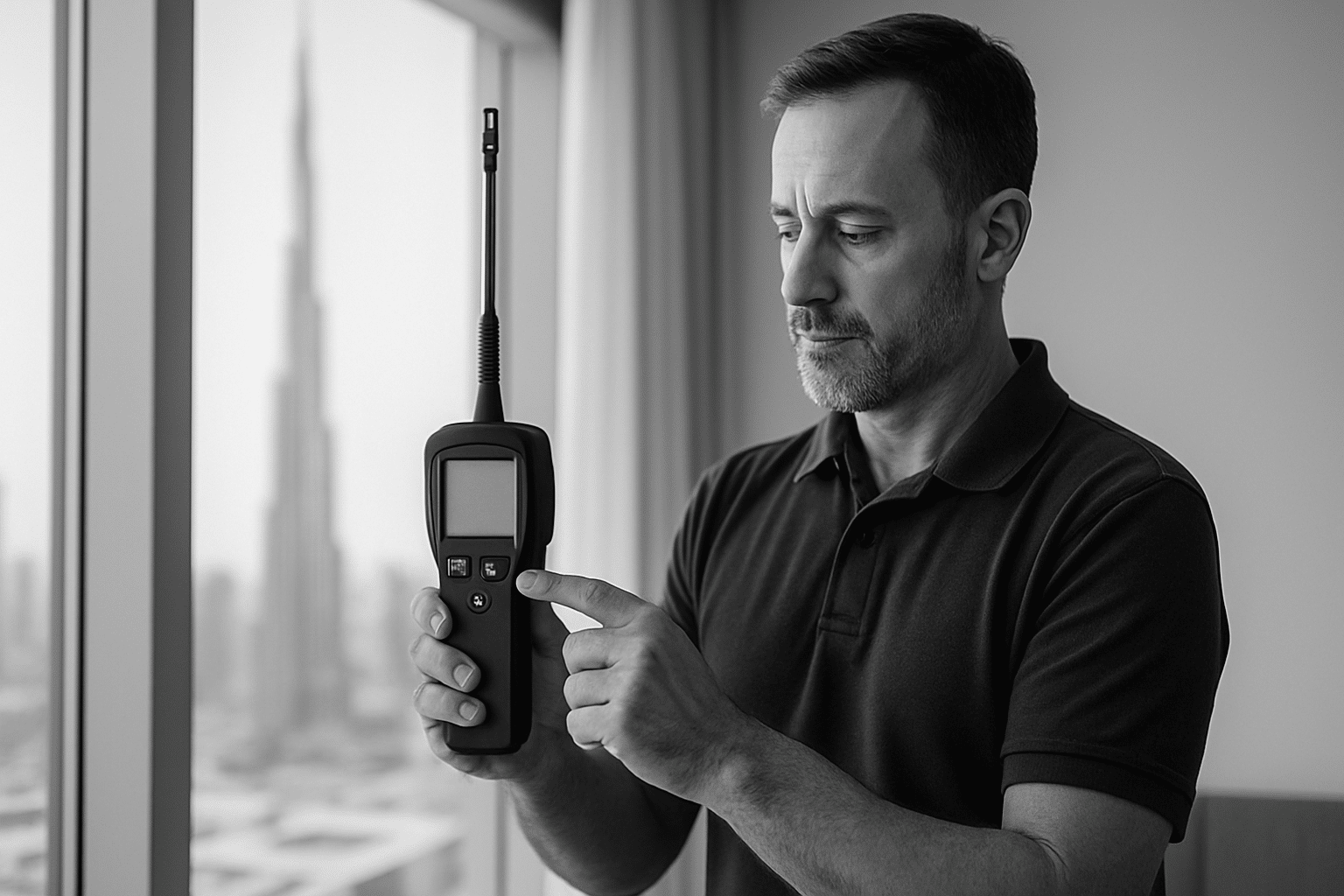
Professional inspectors use moisture meters, thermal imaging cameras and borescopes to examine concealed spaces without destructive testing. Thermal imaging identifies temperature variations that indicate moisture accumulation within walls and ceilings. Moisture meters provide quantitative measurements of material dampness. These tools help identify hidden mold sources before they become extensive problems requiring major remediation.
When to Seek Professional Mold Inspection
How to identify mold growth in your Dubai property yourself has limitations that necessitate professional involvement in certain situations. Seek professional assessment when visible mold covers more than one square metre, when health symptoms persist despite cleaning efforts, when musty odours remain after source identification, or before property purchases to assess potential hidden issues.
Professional inspectors bring specialised equipment, laboratory access and interpretive experience that homeowners cannot replicate. They can identify mold types, concentration levels and appropriate remediation protocols based on scientific assessment rather than guesswork. In Dubai’s unique building environment, professional assessment often reveals interconnected issues involving HVAC systems, building envelope performance and interior moisture management that require integrated solutions. The importance of Identify Mold Growth in Your Dubai Property is evident here.
Expert Tips for Effective Mold Identification
How to identify mold growth in your Dubai property effectively incorporates several professional techniques we use during assessments. Conduct inspections during high humidity periods when mold odours are most pronounced. Use a systematic room-by-room approach with checklist documentation. Employ simple tools like moisture meters available at hardware stores to identify damp materials.
Monitor conditions over time rather than relying on single observations. Take photographs of suspected areas to track progression. Be particularly vigilant after water incidents, plumbing repairs or periods of high humidity. Remember that mold identification is the first step toward resolution – once identified, proper assessment and remediation can address the underlying moisture issues creating the growth environment.
Frequently Asked Questions
How quickly does mold grow in Dubai properties?
In Dubai’s climate, mold can begin growing within 24-48 hours on damp materials under ideal conditions. The combination of high humidity and warm temperatures accelerates microbial growth compared to temperate climates. AC systems that create condensation provide continuous moisture sources that support rapid colonization.
Can I identify mold types myself without laboratory testing?
While visual identification can suggest general categories, accurate species identification requires microscopic analysis. Many mold types appear similar visually but have different health implications and remediation requirements. Professional laboratory analysis provides definitive identification necessary for appropriate response planning.
Does all black discolouration indicate dangerous mold?
Not necessarily. While Stachybotrys chartarum (black mold) receives significant attention, many black-coloured molds are less concerning. Conversely, some lighter coloured molds can produce significant allergens. Colour alone is insufficient for risk assessment – professional identification is recommended for proper evaluation.
How often should Dubai properties be inspected for mold?
We recommend visual inspections quarterly, with particular attention before and after summer humidity periods. Properties with previous water damage history, known moisture issues or occupant sensitivity should consider more frequent monitoring. Professional assessment every 2-3 years provides baseline documentation.
Are mold test kits from hardware stores reliable?
Consumer mold test kits generally provide limited information compared to professional assessment. They typically identify presence/absence but not species or concentration levels. Without professional interpretation, results may cause unnecessary concern or provide false reassurance. Professional assessment with laboratory analysis offers more definitive answers.
Should I test air quality or surfaces for mold identification?
This depends on your specific situation. Air testing identifies airborne spores that may affect respiratory health, while surface testing confirms visible growth identification. Bulk sampling analyzes materials themselves. Professional inspectors determine the appropriate testing strategy based on your property’s specific symptoms and conditions.
Conclusion
How to identify mold growth in your Dubai property involves combining visual inspection, odour detection, health symptom monitoring and sometimes professional testing. Dubai’s unique climate and building practices create specific mold manifestation patterns that require tailored identification approaches. While homeowners can conduct preliminary assessments, professional confirmation through laboratory analysis provides definitive answers when uncertainty exists or health concerns emerge.
Remember that mold identification is the diagnostic phase preceding appropriate remediation. Once growth is confirmed, addressing the underlying moisture sources becomes the priority to prevent recurrence. Whether through DIY monitoring or professional assessment, regular vigilance helps maintain healthier indoor environments in our challenging climate. Understanding Identify Mold Growth in Your Dubai Property is key to success in this area.

JV de Castro, IAC2
JV de Castro is the Chief Technology Officer at Saniservice, where he leads innovation in indoor environmental sciences, IT infrastructure, and digital transformation. With over 20 years of experience spanning architecture, building science, technology management, digital media architecture, and consultancy, he has helped organizations optimize operations through smart solutions and forward-thinking strategies. JV holds a Degree in Architecture, a Masters of Research in Anthropology, an MBA in Digital Communication & Media, along with certifications in mold, building sciences and advanced networking. Passionate about combining technology, health, and sustainability, he continues to drive initiatives that bridge science, IT, and business impact.