Formaldehyde Sources in Dubai Homes and Offices Guide
Formaldehyde Sources in Dubai Homes and Offices are not a single problem with a single fix. They are a pattern — one that emerges from the intersection of rapid construction, climate-specific material behaviour, and buildings designed around full-time air conditioning rather than ventilation. In a city where ambient temperatures regularly exceed 45°C in summer, every material choice made during construction or fit-out carries a chemical consequence that plays out in the air you breathe indoors, day and night.
The World Health Organisation sets a reference indoor concentration of 0.1 mg/m³ (approximately 0.08 ppm) as the ceiling above which health effects become a concern. Field investigations across Dubai villas, apartments, and commercial offices — particularly in newly handed-over or recently renovated properties — frequently return readings that exceed this threshold before the first tenant moves in. The source is rarely a single item. It is typically a cumulative load from multiple emitters operating simultaneously in a thermally stressed environment.
Understanding those sources — and how Dubai’s climate amplifies each one — is the foundation of any credible indoor air quality assessment. What follows is a systematic account of what Saniservice Indoor Sciences investigators commonly encounter during formaldehyde testing across properties in Dubai, Abu Dhabi, Sharjah, Ajman, and Ras Al Khaimah.
Why Dubai’s Climate Makes Formaldehyde Sources in Dubai Homes and Offices Worse
Formaldehyde off-gassing is governed by two primary variables: temperature and relative humidity. Higher temperatures increase the rate at which resin-bound materials release formaldehyde molecules into air. Higher humidity accelerates the hydrolysis of urea-formaldehyde resins — the binders used in most engineered wood products. Dubai’s summer delivers both simultaneously, with outdoor temperatures above 40°C and outdoor relative humidity frequently above 80% during July and August.
What this means in practice is that a piece of flat-pack cabinetry rated at a given emission class under European or North American test conditions will off-gas at a meaningfully higher rate when the same item sits in a UAE property through a Gulf summer. Indoor temperatures in poorly conditioned or newly handed-over spaces can easily reach 35–40°C before occupancy begins — conditions that laboratory emission tests do not replicate.
Additionally, Dubai buildings are sealed environments. Mechanical ventilation rates in residential properties are frequently below ASHRAE 62.1 recommendations. This means formaldehyde accumulates rather than dilutes. The combination of high emission rate and low air exchange is precisely the scenario that pushes indoor concentrations above WHO reference levels.
Engineered Wood and Formaldehyde Sources in Dubai Homes and Offices
Engineered wood products represent the single largest category of formaldehyde sources in Dubai homes and offices, particularly in properties delivered in the last ten years. Medium-density fibreboard (MDF), particleboard, plywood, and oriented strand board (OSB) are all manufactured using urea-formaldehyde resin as the binder that holds wood fibres or veneers together. These resins are not stable in perpetuity — they hydrolyse over time, releasing formaldehyde gas into the surrounding air.
Kitchen and Wardrobe Cabinetry
Kitchen units and built-in wardrobes are among the most formaldehyde-dense installations in any Dubai apartment or villa. The carcase of a standard flat-pack kitchen unit is almost always MDF or particleboard. When a kitchen is fully fitted — base units, wall units, overhead cabinets — the combined surface area of exposed board can exceed 60 to 80 square metres in a mid-sized kitchen. Each square metre is emitting. The enclosed nature of cabinets traps emissions inside and then releases a concentrated burst when doors are opened.
Flooring Underlays and Laminate Cores
Laminate flooring, a common specification in Dubai residential developments, uses a high-density fibreboard core that is bonded with urea-formaldehyde resin. The wear layer and decorative film on top do not seal the core adequately. Emissions pass upward through flooring joins and gaps. In large open-plan living areas — common in Dubai apartment layouts — the total floor area becomes a significant emission source, particularly during the first twelve to twenty-four months after installation.
Furniture Off-Gassing as Formaldehyde Sources in Dubai Homes and Offices
Ready-to-assemble furniture sourced from large-format retail environments is a well-documented contributor to elevated indoor formaldehyde. The issue is not limited to economy-segment products. Even mid-market furniture lines frequently use particleboard or MDF for shelving, drawer bases, and cabinet backs — components that are structurally concealed and therefore not immediately suspected when occupants report irritation symptoms.
In Dubai offices specifically, the simultaneous installation of open-plan workstation systems — hundreds of linear metres of MDF-based panels installed over a short fit-out period — can produce a cumulative formaldehyde load that is challenging to ventilate away without deliberate flush-out protocols before staff occupation. Saniservice Indoor Sciences investigations have documented this pattern in commercial fit-outs across Business Bay, DIFC, and JLT.
The rate of off-gassing from furniture declines over time but is not linear. Temperature spikes — such as those experienced when a furnished property sits unoccupied with AC off during summer — can resharpen emission rates significantly. This is a common scenario in investment properties and holiday homes across Dubai Marina and Palm Jumeirah.
Adhesives, Paints, and Formaldehyde Sources in Dubai Homes and Offices
Construction and finishing materials extend the list of formaldehyde sources in Dubai homes and offices well beyond furniture. Formaldehyde is used as a preservative, cross-linking agent, and binder in a broad range of building products.
Wall Paints and Coatings
Certain interior paints — particularly solvent-borne formulations and some water-based paints that use formaldehyde as a biocide or preservative — off-gas measurable quantities of formaldehyde during and after application. In a freshly painted Dubai apartment that has been closed up during the post-construction phase, paint-related VOC and formaldehyde levels can remain elevated for several weeks. When occupants move in before a proper ventilation period, they absorb that initial peak.
Construction Adhesives and Grouts
Tile adhesives, contact cements used in fitted joinery, and flooring installation adhesives frequently contain formaldehyde-releasing compounds. The quantity emitted per unit area is typically lower than engineered wood, but in a property where every surface has been recently bonded — tiles, skirting boards, architraves, fitted cabinetry — the aggregated contribution is not negligible.
Textiles and Soft Furnishings as Formaldehyde Sources in Dubai Homes
Formaldehyde sources in Dubai homes extend into the soft furnishing category in ways that are frequently overlooked. Wrinkle-resistant and easy-care textiles — curtains, bed linens, upholstered panels — are treated with formaldehyde-based resins to impart crease-resistance. The chemical remains active in the fabric for a period after manufacture and continues to off-gas in warm indoor conditions.
Wall-to-wall carpets, a less common but still present specification in some Dubai villas and hotel-style apartments, can carry formaldehyde in the backing adhesive, the jute or synthetic underlay, and in the carpet fibre itself if a stain-resistant treatment has been applied. Carpet-related emissions are typically lower than engineered wood but add to the cumulative indoor load.
HVAC Systems and Formaldehyde Sources in Dubai Offices
Central air conditioning systems in Dubai buildings do not generate formaldehyde directly, but they interact with formaldehyde sources in two significant ways. First, AC systems recirculate indoor air. In a building with multiple formaldehyde-emitting sources and inadequate fresh air intake, the recirculated air continuously redistributes formaldehyde to every zone connected to the system rather than diluting it through outdoor air exchange.
Second, certain duct lining materials — particularly older or lower-specification fibreglass duct board — may carry adhesives or coatings that off-gas at low levels. In buildings across older districts such as Deira, Al Barsha, and Karama, where AC systems may not have been upgraded with original specifications, this is a contributing factor worth investigating.
Fan coil units fitted with formaldehyde-releasing filter media — a product category that genuinely exists — have also been identified in UAE office environments. The irony of a filter releasing the compound it is marketed to remove is not lost in the field; laboratory verification of filter media before specification is a straightforward precaution.
Green Building Regulations and Material Specifications in the UAE
The UAE’s green building framework — particularly the Dubai Green Building Regulations and the Al Sa’fat rating system — includes provisions for indoor environmental quality. WELL Building Standard W07.3, which covers operational moisture management and material selection, provides a framework for specifying low-emission materials. However, compliance at the material specification stage does not guarantee on-site compliance, particularly when fit-outs are managed by contractors sourcing products outside the original material schedule.
Emirates Green Building Council guidance encourages the adoption of low-VOC and low-formaldehyde materials, including E0 and E1 emission class engineered wood products under European standards, or CARB Phase 2 compliant products under California standards — both of which set limits on allowable formaldehyde emissions from composite wood. However, enforcement at the material-delivery stage remains inconsistent across Dubai’s construction supply chain. Professional pre-occupancy formaldehyde testing remains the most reliable verification mechanism available to property owners and fit-out managers.
Expert Takeaways for Property Owners and Facility Managers
- New properties carry peak risk. The first six to twelve months after handover typically represent the highest formaldehyde emission period. Testing before occupancy, not after symptoms appear, is the appropriate sequence.
- Heat accelerates everything. Properties that have been closed with AC off during summer — investment units, recently renovated properties — should be considered elevated-risk and tested before re-occupation.
- Cumulative load matters. One source at a low level may be acceptable. Five sources at low levels in a sealed, under-ventilated space may not be. Field assessment must account for total room inventory, not individual items in isolation.
- Ventilation is a management tool, not a remedy. Pre-occupancy flush-out protocols can reduce initial formaldehyde peaks but do not eliminate ongoing off-gassing from materials that will continue emitting for years.
- Material certification is not a substitute for air testing. An E1 certificate applies to a sample tested under laboratory conditions. It does not predict performance after shipping, storage, and installation in a Dubai summer.
Frequently Asked Questions
What are the most common formaldehyde sources in Dubai homes?
The most commonly identified formaldehyde sources in Dubai homes are MDF and particleboard cabinetry (kitchens, wardrobes), laminate flooring with fibreboard cores, ready-to-assemble furniture, and wall paints applied without adequate curing time. In newly delivered properties, these sources operate simultaneously, producing a cumulative indoor concentration that frequently exceeds WHO guidelines before occupancy begins.
How does Dubai’s heat affect indoor formaldehyde levels?
Elevated temperatures directly increase formaldehyde off-gassing rates from resin-bonded materials. Properties that have been closed during a Dubai summer — with internal temperatures potentially reaching 35–40°C — can experience significantly elevated formaldehyde concentrations when first opened. This is a recurring pattern in investment properties and second homes across Dubai Marina, Palm Jumeirah, and Jumeirah Village Circle.
When should I arrange formaldehyde testing in a UAE property?
Formaldehyde testing is most valuable before first occupancy of a newly built or recently renovated property, after installation of new fitted cabinetry or flooring, and when occupants report persistent irritation of the eyes, nose, or throat without an identified cause. As an IAC2 Certified Indoor Air Consultant, the recommendation is to test before symptoms develop rather than in response to them.
How long does formaldehyde off-gas from new furniture in Dubai?
Off-gassing from engineered wood furniture typically follows a declining curve over two to three years, with the highest emission rate during the first six to twelve months. In Dubai’s climate, elevated temperatures during summer can extend and resharpen this curve. Materials in direct sunlight or in rooms without consistent air conditioning may continue to emit at higher rates for longer than laboratory estimates suggest.
Is formaldehyde a concern in Dubai offices as well as homes?
Yes. Formaldehyde sources in Dubai offices include workstation panel systems, suspended ceiling tiles with fibreboard cores, fresh carpet installations, and adhesives used during fit-out. Open-plan office fit-outs in districts such as DIFC, Business Bay, and JLT commonly involve large volumes of these materials installed over a compressed construction period, creating a high cumulative emission load at handover.
Does the UAE have regulations limiting indoor formaldehyde levels?
The UAE’s green building frameworks — including Dubai Green Building Regulations and the Al Sa’fat system — reference indoor air quality standards and encourage low-emission material specifications. The WHO guideline value of 0.1 mg/m³ is the internationally recognised indoor reference level. However, enforcement through air testing at the point of handover is not yet universally mandated, making independent professional assessment the most reliable path to verified compliance.
Can formaldehyde be detected without professional equipment?
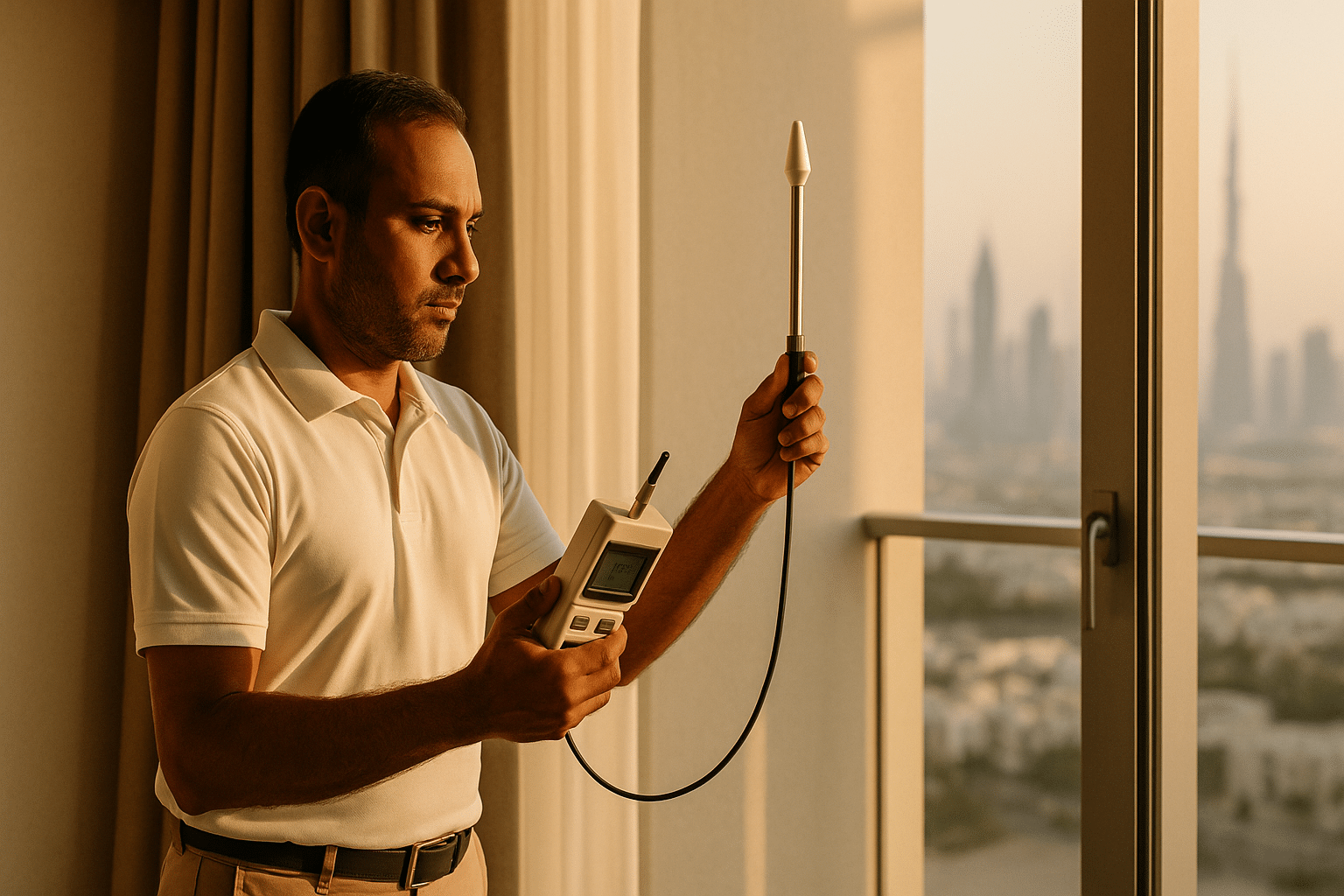
Consumer indicator badges and colorimetric tube kits can provide a rough indication of formaldehyde presence, but they do not produce the measurement precision required for regulatory comparison, health-risk assessment, or source attribution. Laboratory-grade active sampling — the methodology used by Saniservice Indoor Sciences — returns quantified results in µg/m³ that can be directly compared against WHO and ASHRAE reference values with documented chain of custody.
Conclusion
Formaldehyde Sources in Dubai Homes and Offices represent a layered problem that cannot be resolved by identifying and replacing a single item. The materials that emit formaldehyde — engineered wood, adhesives, textiles, coatings — are fundamental to how most Dubai properties are built and furnished. Dubai’s climate does not neutralise those sources; it amplifies them. Every degree of elevated temperature and every unit of recirculated air without adequate fresh air exchange works against the occupant.
The appropriate response to formaldehyde concern is not alarm — it is measurement. A calibrated formaldehyde assessment, conducted by an IAC2 certified Indoor Air Consultant using laboratory-verified active sampling, produces a result that can be acted upon: a number, a source attribution, and a prioritised remediation pathway. Saniservice Indoor Sciences offers this assessment across Dubai, Abu Dhabi, Sharjah, Ajman, and Ras Al Khaimah for both residential and commercial properties. The starting point is always the same: measure first, conclude from evidence, act with precision. Understanding Formaldehyde Sources in Dubai Homes and Offices is key to success in this area.