WHO Formaldehyde Limits and Indoor Air Standards Dubai Guide
WHO Formaldehyde Limits and Indoor Air Standards represent the evidence base that any credible indoor air assessment must start from. The World Health Organisation guideline of 0.1 mg/m³ (approximately 0.08 ppm) as a 30-minute ceiling value is not arbitrary — it is derived from decades of epidemiological and toxicological research linking formaldehyde exposure to sensory irritation, respiratory effects, and, at sustained elevated concentrations, nasopharyngeal cancer risk. In Dubai, where a newly furnished apartment can reach ambient formaldehyde concentrations several times that ceiling within the first weeks of occupancy, understanding where the standard comes from and how it compares to other regulatory frameworks is practical knowledge, not academic detail.
Multiple bodies have published formaldehyde standards: the WHO, the US Environmental Protection Agency, the European Committee for Standardisation, ASHRAE, and various green building rating systems including WELL and LEED. Each uses different averaging times, measurement methods, and enforcement contexts. For property owners in Dubai, Abu Dhabi, and Sharjah, the question is not simply which number is lowest — it is which framework is most protective given UAE building conditions, and how a professional laboratory result should be interpreted against each benchmark.
This article compares the major WHO Formaldehyde Limits and indoor air standards side by side, explains the science behind the differences, and provides a structured framework for understanding what a professional formaldehyde test result in Dubai actually means.
What the WHO Guideline Actually Says
The WHO formaldehyde limits and indoor air standards are published in the WHO Guidelines for Indoor Air Quality, most recently updated through the WHO’s indoor air quality programme. The core guideline is 0.1 mg/m³ measured as a 30-minute average. This value was selected because it represents the lowest concentration at which sensory irritation — eye, nose, and throat effects — becomes statistically detectable in controlled human exposure studies.
The WHO does not publish a 24-hour or annual average for formaldehyde in the same way it does for particulate matter. This is deliberate. Formaldehyde’s primary acute effects occur at peak concentrations rather than through cumulative low-level exposure alone. The 30-minute window is therefore a ceiling limit, not a time-weighted average. Exceeding it briefly during, say, a cooking event is different from sustaining it across an entire workday in an office fitted with new composite-board furniture.
The WHO also classifies formaldehyde as a Group 1 human carcinogen (IARC classification), which means the standard is set with the understanding that there is no demonstrably safe threshold for carcinogenic effect. The 0.1 mg/m³ guideline is protective against sensory irritation; it does not imply that concentrations below this level carry zero long-term risk. This distinction matters when advising clients in Dubai about newly renovated spaces.
Comparing WHO Formaldehyde Limits and Indoor Air Standards Globally
US EPA and OSHA Reference Values
The US EPA does not set a legally enforceable indoor air standard for formaldehyde in non-occupational settings. Instead, it publishes a chronic oral reference dose and references the IARC carcinogen classification. OSHA regulates occupational exposure with a permissible exposure limit (PEL) of 0.75 ppm (approximately 0.92 mg/m³) as an 8-hour time-weighted average, with a short-term exposure limit (STEL) of 2 ppm. These occupational limits are considerably higher than the WHO guideline because they were set to protect workers in industrial settings, not residents sleeping in a bedroom.
The contrast is significant. A Dubai office that measures 0.3 mg/m³ would pass OSHA’s occupational benchmark but would exceed the WHO formaldehyde limits and indoor air standards by a factor of three. Citing OSHA in a residential context is technically defensible but ethically misaligned with the purpose of indoor air quality assessment.
European EN 16516 and EU Regulation
The European Committee for Standardisation uses EN 16516 as the test method for measuring formaldehyde emissions from construction products. The EU Construction Products Regulation references a 0.1 mg/m³ threshold — aligned with the WHO guideline — as the indoor air quality criterion against which product emissions are evaluated. This alignment means that European-sourced construction materials and furniture tested under EN 16516 are, in principle, assessed against the same ceiling the WHO sets for occupied space.
In practice, however, EN 16516 is a product-emission standard, not an ambient air standard. A product can pass EN 16516 testing in isolation but contribute to exceedances in a real room because of additive emissions from multiple sources. WHO formaldehyde limits and indoor air standards apply to the air occupants breathe, not to individual product emissions in a chamber.
WELL Building Standard
The WELL Building Standard, widely referenced in Dubai’s premium commercial and residential developments, sets a formaldehyde limit of 27 ppb (approximately 0.033 mg/m³) for occupied spaces — significantly more stringent than the WHO guideline. WELL requires this to be verified through post-occupancy air testing, not product documentation alone. For Indoor Sciences assessment projects aligned with WELL preconditions, this lower threshold becomes the operative benchmark.
ASHRAE 62.1 and Ventilation-Based Approaches
ASHRAE 62.1, the ventilation standard most commonly referenced in UAE commercial construction, does not set a numerical formaldehyde limit directly. Instead, it establishes minimum ventilation rates intended to dilute contaminants including formaldehyde to acceptable concentrations. The assumption embedded in ASHRAE 62.1 is that adequate outdoor air supply will keep formaldehyde below WHO formaldehyde limits and indoor air standards without requiring source-specific measurement. In Dubai’s climate, where outdoor air supply is constrained by extreme summer temperatures and HVAC systems routinely operate in recirculation-heavy modes to manage cooling loads, this dilution assumption frequently fails.
Side-by-Side Comparison of Major Standards
The following structured comparison allows property professionals and facility managers in the UAE to evaluate which framework applies to their context.
- WHO Indoor Air Quality Guideline: 0.1 mg/m³ (30-minute average) — applies to all indoor environments; most relevant to residential and public building assessment.
- OSHA PEL (USA, occupational): 0.75 ppm (≈ 0.92 mg/m³, 8-hour TWA) — occupational settings only; not appropriate for residential benchmarking.
- EU Construction Products Regulation: 0.1 mg/m³ — product-emission criterion; aligned with WHO but measured at source, not in occupied air.
- WELL Building Standard v2: 27 ppb (≈ 0.033 mg/m³) — most protective; required for WELL certification; post-occupancy air testing mandatory.
- LEED v4 EQc2 (Low-Emitting Materials): References product certification categories; does not set a direct ambient concentration limit but restricts product emissions through approved certification programmes.
- China GB/T 18883: 0.1 mg/m³ (1-hour average) — comparable to WHO but uses different averaging window; relevant given volume of Chinese-manufactured furniture and laminates in UAE market.
The practical conclusion from this comparison is that WHO formaldehyde limits and indoor air standards sit at the centre of the evidence-based range. They are more protective than occupational standards and more lenient than WELL. For most Dubai residential and office assessments, the WHO threshold is the appropriate operational benchmark.
Why Dubai Conditions Require Closer Attention to WHO Formaldehyde Limits and Indoor Air Standards
Formaldehyde off-gassing from composite wood products, adhesives, fabric treatments, and foam insulation is temperature-dependent. Emission rates approximately double for every 10°C increase in ambient temperature. In a Dubai apartment during summer, interior temperatures can reach 28–32°C even with air conditioning, and surfaces of furniture in direct sunlight can reach considerably higher. This means that a product tested for formaldehyde emissions at a European laboratory at 23°C will off-gas at meaningfully higher rates in a UAE indoor environment.
Relative humidity is the second variable. Formaldehyde dissolves readily in water vapour. Higher indoor humidity — common in Dubai apartments during the summer condensation season — can increase formaldehyde’s apparent concentration in settled air near surfaces. Conversely, extremely low humidity in over-cooled interiors can reduce moisture-binding and leave more free formaldehyde airborne. Neither extreme is neutral relative to WHO formaldehyde limits and indoor air standards.
The combination of new construction, rapid interior fit-out schedules, high-emission furniture packages sourced from mixed international markets, and a climate that accelerates off-gassing creates a risk profile in Dubai that is not well captured by standards developed in temperate climates. This is precisely why ambient air testing — not product documentation review — is the only reliable verification method in this context.
How Professional Formaldehyde Testing Measures Against WHO Standards
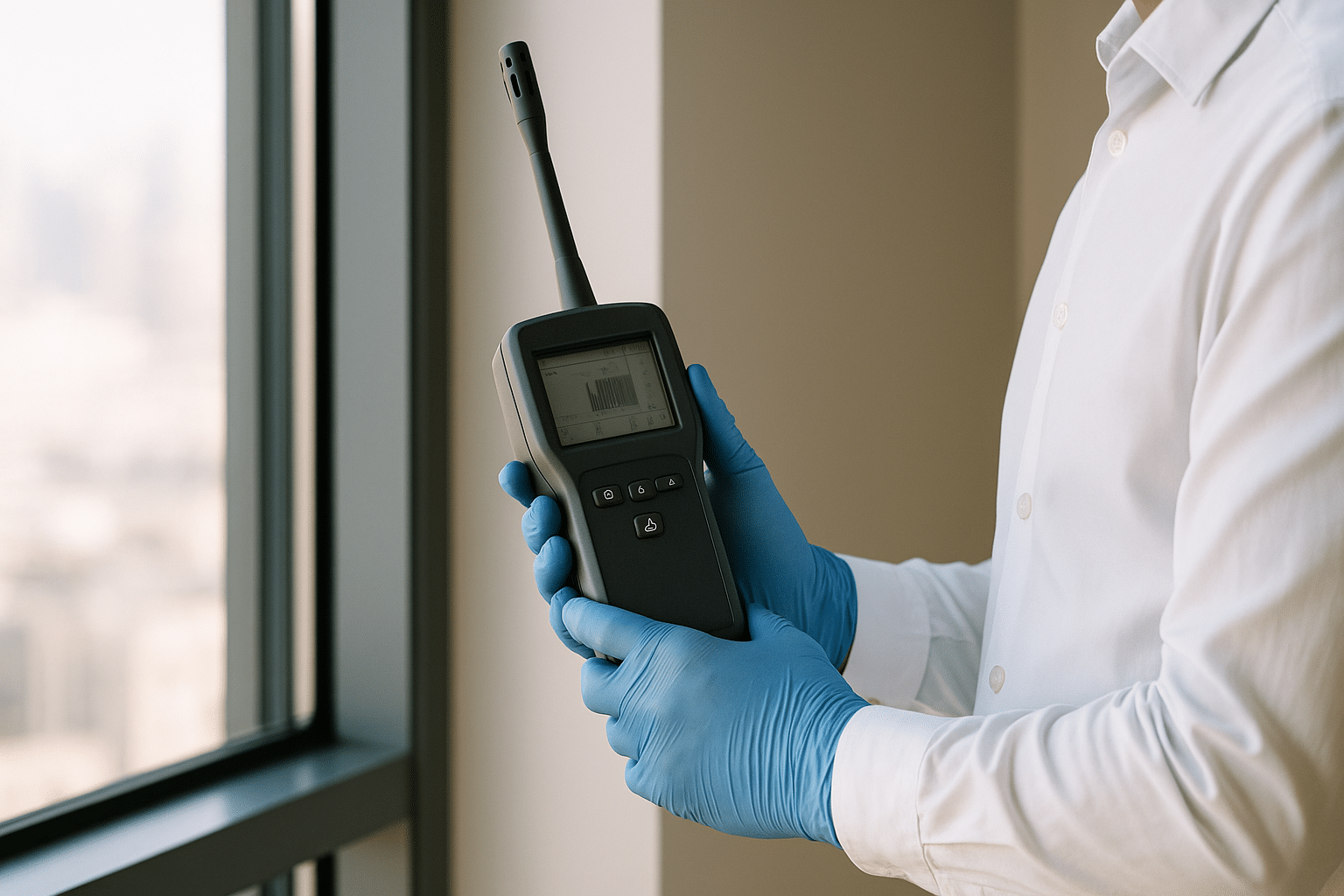
As an IAC2 Certified Indoor Air Consultant, the approach at Indoor Sciences is to measure ambient formaldehyde using active sampling with DNPH-coated sorbent tubes, analysed by HPLC in the in-house microbiology and chemistry laboratory. This method aligns with ISO 16000-3, the internationally recognised sampling and analysis protocol for indoor formaldehyde. Results are expressed in µg/m³ and directly compared to WHO formaldehyde limits and indoor air standards as the primary benchmark, with WELL criteria applied where the client’s project requires certification-level verification.
A single-point measurement is rarely sufficient. Professional assessment in a Dubai villa or office suite typically involves multiple spatial samples — near identified emission sources, at breathing height in frequently occupied zones, and in areas with restricted ventilation. Temporal sampling matters as well: concentrations measured immediately after morning AC start-up differ from those measured after four hours of building operation.
Laboratory turnaround at Indoor Sciences is measured in days, not weeks. This matters because formaldehyde concentrations in a new Dubai apartment or a post-renovation office change rapidly in the first months of occupancy. A result that is actionable within 48–72 hours of sampling allows clients to make ventilation and source-control decisions while the situation is still dynamic.
Pros and Cons of Each Standard Framework for UAE Applications
WHO Guideline — Pros and Cons
Pros: Evidence-based, internationally recognised, protective for general populations including children and sensitive individuals, directly applicable to residential and commercial ambient air assessment.
Cons: The 30-minute averaging period requires careful field protocol to implement correctly; does not account for cumulative low-level carcinogenic risk at concentrations below the sensory irritation threshold.
WELL Standard — Pros and Cons
Pros: Most health-protective threshold available; mandatory post-occupancy testing removes reliance on product documentation; increasingly required by Dubai’s premium commercial tenants and developers.
Cons: The 0.033 mg/m³ limit is technically demanding to achieve in newly fitted-out spaces; may require extended pre-occupancy flush-out periods of 14 days or more, which has cost and scheduling implications in UAE construction timelines.
Occupational Standards (OSHA) — Pros and Cons
Pros: Legally established and familiar to built-environment professionals from US-trained backgrounds.
Cons: Wholly inappropriate for residential or general commercial IAQ assessment in the UAE context; would permit concentrations nine times the WHO guideline in a home where children sleep.
Expert Takeaways for Property Professionals in Dubai
- Always benchmark a formaldehyde test result against the WHO formaldehyde limits and indoor air standards first, not occupational or product-emission standards.
- Request ISO 16000-3 compliant sampling methodology from any laboratory you engage — this is the method that produces results directly comparable to the WHO guideline.
- In WELL or LEED-targeted projects, apply the WELL threshold of 0.033 mg/m³ as the operative limit, not the WHO ceiling.
- Account for seasonal variation: testing conducted in winter months in Dubai may underestimate peak summer formaldehyde concentrations by a meaningful margin.
- Post-renovation and post-fit-out testing should occur no earlier than 48 hours after the space has been conditioned at normal occupancy temperature, with windows and external doors closed for at least 8 hours prior to sampling.
- Where results exceed the WHO threshold, source identification — not simply increased ventilation — is the first investigative step. Ventilation dilutes; it does not eliminate the emission source.
Frequently Asked Questions
What is the WHO formaldehyde limit for indoor air?
The WHO guideline for indoor formaldehyde is 0.1 mg/m³ measured as a 30-minute average. This value is set to protect against sensory irritation — eye, nose, and throat effects — in the general population, including children and sensitive individuals. It applies to all indoor environments, including homes, schools, and offices.
How do WHO formaldehyde limits and indoor air standards compare to WELL Building Standard requirements?
The WELL Building Standard v2 sets a significantly more protective threshold of 27 ppb (approximately 0.033 mg/m³), which is roughly three times lower than the WHO guideline. WELL also requires post-occupancy ambient air testing to verify compliance, whereas the WHO guideline is a public health reference value rather than a certification requirement.
Is formaldehyde testing mandatory in Dubai?
There is no single UAE-wide mandatory formaldehyde testing regulation for all buildings. However, Dubai Municipality’s green building regulations, ESMA product safety standards, and WELL or LEED certification requirements used in premium developments all incorporate formaldehyde limits. Professional assessment is strongly advised following renovation, new furniture installation, or when occupants report persistent respiratory irritation.
Why are formaldehyde levels higher in Dubai apartments than in European homes?
Formaldehyde off-gassing rates increase with temperature. Dubai’s indoor temperatures, even when air-conditioned, are typically higher than those in temperate climates where most product emission testing is conducted. A product that meets European emission standards at 23°C may produce measurably higher formaldehyde concentrations in a Dubai apartment operating at 27–30°C during summer months.
What sampling method should be used to test against WHO formaldehyde limits and indoor air standards?
ISO 16000-3 is the internationally recognised method for indoor formaldehyde sampling. It uses active air sampling with DNPH-coated sorbent tubes, analysed by high-performance liquid chromatography (HPLC). Results produced by this method are directly comparable to the WHO guideline of 0.1 mg/m³ and to the WELL threshold of 0.033 mg/m³.
How long should a Dubai apartment be closed before formaldehyde testing?
Professional protocol requires the space to be closed — windows and external doors shut — for a minimum of 8 hours prior to sampling, with the HVAC system operating at normal occupancy settings. In practice, Indoor Sciences field investigations in Dubai villas and apartments typically use a 12-hour closure period to account for the volume of air in larger UAE residential properties.
Can ventilation alone bring formaldehyde below WHO indoor air standards in a newly furnished space?
Ventilation can reduce ambient formaldehyde concentrations by dilution, but it does not remove the emission source. In a Dubai apartment with freshly installed laminate flooring, composite furniture, and adhesive-backed wallcoverings, sustained mechanical ventilation will lower concentrations temporarily. However, concentrations will rebound once ventilation returns to normal occupancy rates unless the source materials are allowed to fully off-gas — a process that typically takes 3 to 24 months depending on material type and ambient conditions.
Conclusion
WHO formaldehyde limits and indoor air standards provide the most widely applicable and evidence-grounded benchmark for assessing indoor formaldehyde risk in Dubai’s residential and commercial buildings. At 0.1 mg/m³ measured over 30 minutes, the WHO guideline sits between the more lenient occupational thresholds that have no place in a home assessment and the more demanding WELL certification threshold required by Dubai’s premium development sector. Understanding where each framework applies — and why occupational limits should never be used to assess residential risk — is the difference between a technically valid report and a misleading one.
In a city where new fit-outs happen constantly, furniture sourcing is global, and summer temperatures accelerate every chemical emission process in the building envelope, WHO formaldehyde limits and indoor air standards are not a technicality. They are a practical protection standard. If you are managing a new apartment, a post-renovation office in Business Bay, or a school in Abu Dhabi where occupants are reporting persistent irritation, the first step is not speculation — it is measurement against the correct benchmark, using a verified method, from a laboratory that can return results before the problem worsens. That is what science-grade indoor air assessment looks like in the UAE.