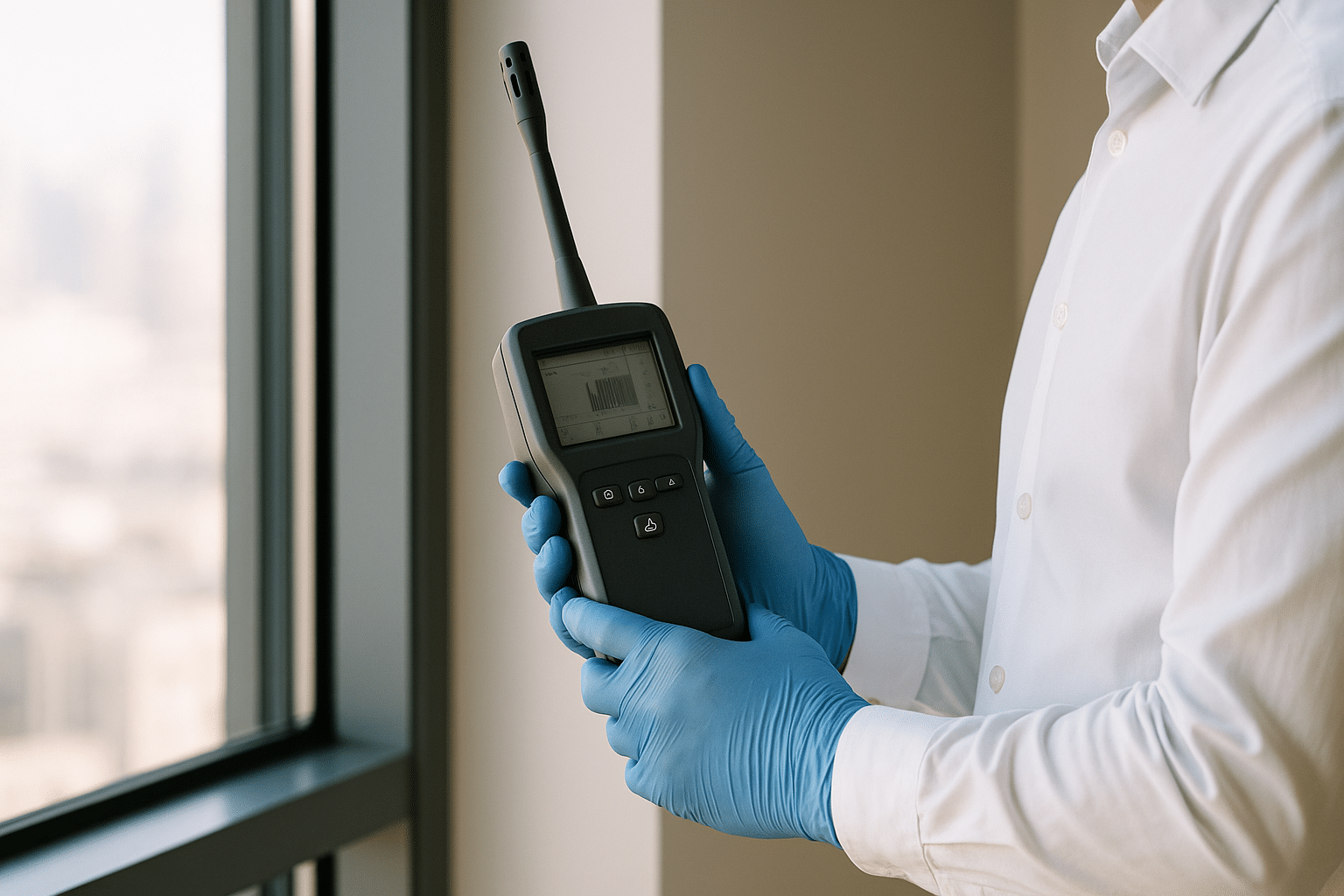
Why Chain of Custody Matters in Environmental Genomics
Chain of Custody in Environmental Genomics Sampling is the formal, unbroken record that follows a sample from the moment it is collected until the laboratory issues a final report. It documents who collected the sample, under what conditions, using which containers, how the sample was transported, who received it, and how it was stored before analysis. Without this record, a genomic result — however technically sophisticated — cannot be defended as evidence of building conditions at the time of sampling. In a field where DNA sequencing can identify organisms at species and even strain level, a compromised chain of custody turns precision data into inadmissible noise.
In the UAE, this matters more than in many other climates. Buildings here cycle between 45°C outdoor air and aggressively cooled interiors. Condensation forms inside wall cavities, inside ductwork, and at thermal bridges that standard construction details rarely anticipate. The microbial communities that develop under these conditions are thermophilic and xerophilic — species adapted to heat and moisture stress that do not match the temperate-climate reference libraries most commercial labs were built around. When Indoor Sciences at Saniservice analyses environmental genomic samples from Dubai villas, Abu Dhabi apartments, or Sharjah commercial spaces, the laboratory result is only as reliable as the handling that preceded it.
This article walks through every stage of the custody process: what each step requires, where errors most commonly occur, and what a properly documented sample chain looks like by the time it reaches the sequencer.
What the Chain Actually Covers
The phrase “chain of custody” originates in forensic science, where it describes the legal standard of evidence preservation. Environmental science adopted the concept because biological and chemical samples degrade, transform, or become contaminated when handled carelessly. In genomics, the stakes are particularly high: DNA is fragile, and amplification-based methods like PCR and next-generation sequencing will detect whatever is present at analysis — including contaminants introduced after collection.
A complete chain covers five domains: collection documentation, container integrity, temperature and time control during transport, laboratory receipt and intake logging, and storage conditions prior to extraction. Each domain has failure modes. A gap in any one of them does not merely reduce confidence in a single data point — it can invalidate an entire sample set.
Collection Documentation at the Site
The chain begins before the sampler touches any surface. Field documentation must record the date and time of collection to the nearest minute, the precise location within the building (room, elevation, substrate), the sampling method used (swab, vacuum cassette, bulk material, air impaction), and the environmental conditions at the moment of collection — temperature, relative humidity, and any recent disturbances such as cleaning, HVAC maintenance, or occupant activity.
In UAE field investigations, ambient conditions are particularly relevant. An indoor humidity reading of 68% at a wall surface versus 42% in the centre of a room tells a different interpretive story. That reading should appear in the chain record alongside the GPS coordinates or building floor plan reference for the exact sampling point. Field notes are not optional annotations — they are part of the evidentiary record.
Sampler Identification and Training
Every sample must be associated with an identified, credentialled collector. IAC2 standards require that environmental samples collected for professional interpretation are gathered by trained personnel who understand contamination avoidance, appropriate personal protective equipment, and the biomass limitations of different substrate types. In a genomics context, this is non-negotiable: a swab introduced by an uncertified individual wearing no gloves is a DNA contamination event, not a sample.
Container Labelling at Point of Collection
Containers must be labelled at the moment of collection, not later at a desk or in a vehicle. The label must include a unique sample identifier that matches the field sheet, the collection date and time, and the collector’s identification. Pre-printed barcoded labels bonded to sterile tubes are the current best practice. Any label applied after the collection event introduces a documentation gap — a small one, perhaps, but sufficient to raise doubt in a professional remediation dispute or a building handover disagreement.
Container Integrity and Sterility Standards
Genomic sampling requires sterile, DNA-free collection materials. This is not the same as microbiologically clean. A container that has been autoclaved for bacterial culture may still carry trace DNA from a previous occupant that survives sterilisation and amplifies during PCR. Genomics-grade tubes and swabs are manufactured to certified absence of detectable nucleic acids. Using substitutes — even clean-looking ones — introduces a material risk of false-positive amplification.
For air samples captured on filter membranes, the membrane material itself must be verified as genomics-compatible. Certain fibreglass media used in standard particulate sampling bind DNA poorly or introduce inhibitory substances that affect downstream extraction yields. Polycarbonate and PTFE membranes at appropriate pore sizes are generally preferred for molecular work. Field investigators sourcing their own consumables without laboratory guidance frequently introduce this error without realising it.
Transport Conditions and Time Sensitivity
Microbial DNA in environmental samples is not static. At elevated temperatures, cellular membranes rupture, releasing DNases that degrade target sequences. At the same time, viable organisms in moist samples continue to grow during transit, shifting community composition away from what existed at the time of collection. Both processes corrupt genomic data.
Standard protocol requires samples destined for DNA-based analysis to be maintained at 2–8°C during transit, transported in sealed, tamper-evident packaging, and delivered to the laboratory within a validated holding time — typically 24 to 48 hours for most substrate types, shorter for high-moisture bulk materials. In Dubai, where ambient temperatures exceed 40°C during summer months, a sample left in a vehicle while a consultant completes paperwork can experience a temperature excursion that ruins it entirely. Cold chain documentation — time-stamped temperature logs from collection to laboratory receipt — is part of the custody record.
Courier Accountability
When samples are transferred to a courier rather than hand-delivered, each transfer point must be documented. The person releasing the samples and the person receiving them both sign the chain of custody form. This creates an auditable record of possession at every handoff. In practice, many environmental companies in the UAE still use informal courier arrangements without custody transfer signatures — an oversight that would not survive scrutiny in a litigation context.
Laboratory Receipt and Intake Procedures
At the laboratory, receipt is its own formal event. Intake staff verify that the sample count matches the field manifest, inspect containers for damage or leakage, confirm that temperature logs are within specification, and log the samples into the laboratory information management system under the original field identifiers. Any discrepancy — a missing sample, a compromised container, a temperature excursion — is documented and communicated to the collecting party before analysis begins.
At Saniservice’s in-house Indoor Sciences laboratory in Al Quoz, receipt documentation is timestamped and cross-referenced against field collection records before samples are allocated to analysts. This intake step is where the laboratory formally accepts — or formally rejects — custody. A rejected sample is returned with a written explanation, not silently discarded or analysed under caveat.
Storage Before Extraction
Samples awaiting extraction must be held under conditions validated for the specific matrix and target organism class. Swabs and filter membranes are typically stored at −20°C when extraction will not occur within 48 hours. Bulk material samples with high organic content may require −80°C storage for extended holding periods. The laboratory must maintain temperature logs for all storage units, with alarm thresholds that trigger investigation protocols if excursions occur.
Storage documentation closes the pre-analytical phase of the chain. Everything that follows — extraction, amplification, sequencing, bioinformatic analysis — occurs within the laboratory’s internal quality management system and is governed by separate analytical protocols. But those protocols are only meaningful if the pre-analytical chain remained intact.
Documentation Formats and Legal Weight
A chain of custody form is a legal document. It must be resistant to post-hoc alteration. Paper forms should use tamper-evident design features; electronic systems require audit trails that record every edit with a timestamp and user identification. ISO 17025 accredited laboratories — the internationally recognised standard for testing and calibration laboratory competence — maintain chain of custody records as part of their quality management obligations. When requesting genomic environmental testing in the UAE, confirming that the laboratory operates under ISO 17025 or an equivalent documented quality framework is a reasonable and legitimate question for any client to ask.
Field Blanks and Negative Controls
Professional genomics sampling includes field blanks — containers opened, exposed to ambient air at the sampling site, then resealed without contacting any target surface. These blanks travel through the entire chain and are analysed alongside real samples. If a field blank returns a positive amplification result, it indicates contamination was introduced somewhere in the pre-analytical process, not at the building surface. This control mechanism is what separates a rigorous sampling programme from a sampling event that only appears rigorous.
Common Failure Modes in UAE Building Investigations
Based on field investigations across Dubai, Abu Dhabi, and Sharjah, several failure modes recur in environmental genomic sampling work in the UAE. Samples collected in non-genomics-grade containers are the most frequent. Cold chain failures during summer transport are the second most common. Incomplete field documentation — particularly missing humidity readings and sampling time — is the third.
A less visible problem is inconsistent sampler training. When a building investigation uses multiple technicians without a unified protocol, the samples become methodologically incomparable even if the laboratory analysis is technically sound. A remediation decision made on incomparable samples is a decision made without reliable data, regardless of how sophisticated the sequencing technology was.
Key Takeaways for Building Owners and Facility Managers
- Request a written sampling protocol before any genomic environmental work begins. If the provider cannot produce one, that is your answer about the quality of their process.
- Ask specifically whether the laboratory receiving your samples is ISO 17025 accredited or operates under an equivalent documented quality framework.
- Confirm that cold chain documentation will be included in your report, not just the sequencing results.
- Insist that field blanks and negative controls are part of the sampling programme. They are not optional extras — they are the quality control that gives your results meaning.
- In UAE summer conditions, verify that the sampling provider uses validated insulated transport containers with temperature loggers, not improvised cooler bags.
Frequently Asked Questions
What is chain of custody in environmental genomics sampling?
Chain of Custody in Environmental Genomics Sampling is the documented, unbroken record tracking a sample from field collection through laboratory analysis. It records who collected the sample, under what conditions, how it was transported, and who handled it at each stage. This documentation ensures that genomic results are scientifically defensible and have not been compromised by contamination, temperature excursion, or improper handling.
Why does chain of custody matter more for genomics than standard culture testing?
DNA-based methods amplify whatever nucleic acid is present in a sample — including contaminants introduced after collection. A culture test requires a viable organism to grow; a PCR-based method will detect trace DNA from a glove touch or an improperly sterilised tube. This sensitivity makes pre-analytical sample integrity far more consequential in genomic work than in conventional microbiological testing.
How does Dubai’s climate affect sample handling requirements?
Outdoor temperatures in Dubai regularly exceed 40°C, meaning any sample left unrefrigerated degrades rapidly. Cellular DNases activate at elevated temperatures, breaking down target sequences. In summer months, validated insulated transport containers with temperature loggers are essential, not optional. Cold chain documentation should be included in the laboratory report as evidence that holding conditions were maintained throughout transit.
What is a field blank and why is it included in a genomic sampling programme?
A field blank is a clean, genomics-grade container opened at the sampling site, exposed briefly to ambient conditions, then sealed without contacting any surface. It travels through the entire sample chain and is analysed alongside real samples. If a field blank tests positive, it indicates contamination entered the process somewhere pre-analytically, which would compromise the interpretation of real samples collected at the same time.
What accreditation should a UAE laboratory hold for environmental genomic testing?
ISO 17025 is the internationally recognised accreditation standard for testing and calibration laboratories. It requires documented quality management systems, competency verification for analysts, and traceable chain of custody records. When commissioning genomic environmental testing in the UAE — whether in Dubai, Abu Dhabi, or Sharjah — confirming that the laboratory holds or operates under ISO 17025 principles is a legitimate and prudent requirement.
Can a chain of custody failure invalidate an entire sampling event?
Yes. A documented temperature excursion, a missing field blank, unlabelled containers, or an unsigned custody transfer can render a sample set scientifically indefensible. In remediation disputes, building handovers, or regulatory submissions, results produced from a compromised chain cannot be reliably attributed to the conditions present in the building at the time of sampling. Retesting under a documented protocol is typically the only remedy.
How do I verify that my environmental genomics provider follows a proper chain of custody?
Ask for their written sampling protocol before work begins. Confirm they use genomics-grade, DNA-free collection consumables. Ask whether cold chain documentation is included in the final report. Request confirmation that field blanks and negative controls are part of the programme. A professional laboratory-backed service will answer all of these questions without hesitation and will provide documentation as standard, not on request.
Chain of Custody in Environmental Genomics Sampling is not a procedural formality — it is the structural foundation that determines whether a genomic result describes your building or describes the errors introduced between your building and the sequencer. In a climate as unforgiving as the UAE’s, where microbial communities behave differently from temperate-region reference databases and sample degradation can occur within minutes of collection in summer conditions, the rigour of the custody process is inseparable from the scientific value of the result. Before commissioning any molecular environmental testing, the first question to ask is not what organism the test can detect — it is whether the handling process is documented well enough for the answer to mean anything.