What Does Microbiological Testing Find in Dubai Water?
What Microbiological Testing reveals in Dubai water is rarely what residents expect. Most people assume that water leaving DEWA’s treatment facilities is the water arriving at their taps. The reality is more complex: between the treatment plant and the point of use, water travels through distribution mains, enters rooftop or basement storage tanks, and passes through building-internal plumbing — each stage representing an opportunity for microbial change. Laboratory analysis of water samples from UAE properties consistently identifies organisms and contamination signatures that chemical testing alone would miss entirely.
The UAE’s climate creates conditions that accelerate microbial activity in ways that colder or more temperate climates simply do not. Water stored in rooftop tanks can reach temperatures exceeding 45°C during summer months. At those temperatures, certain bacteria multiply rapidly, disinfectant residuals degrade faster, and biofilm formation on tank walls and pipe interiors becomes an ongoing process rather than an occasional event. This is not a failure of municipal supply — it is a consequence of the building environment that the municipality cannot control once water enters private storage.
Professional microbiological testing provides a measurable answer to a question that guesswork cannot resolve: what is actually in the water at the point of use, and does it meet established health benchmarks?
The Organisms That Laboratory Analysis Targets
A standard microbiological water test in the UAE evaluates a defined panel of indicator organisms and pathogens. These are not random selections — each target has a specific relevance to human health and to the conditions commonly found in UAE building water systems.
Total Coliform Bacteria
Total coliforms are the primary indicator group used in water quality assessment. Their presence does not automatically confirm faecal contamination, but it signals that the water has been exposed to conditions that allow bacterial growth — and that further investigation is warranted. In tank-dependent systems, total coliforms commonly appear when residual chlorine has been depleted and biofilm has established itself on storage surfaces.
Escherichia coli and Thermotolerant Coliforms
E. coli detection in a water sample is a more serious finding. It is the definitive indicator of faecal contamination and represents a direct public health concern. In UAE building water systems, E. coli findings during microbiological testing are most frequently traced to compromised tank integrity — cracked lids, inadequate sealing, cross-contamination from maintenance activities, or pest access. A single confirmed E. coli result requires immediate investigation and remediation.
Heterotrophic Plate Count
The heterotrophic plate count, or HPC, measures the total population of culturable bacteria present in a water sample. Elevated HPC values indicate that bacterial growth has occurred within the distribution or storage system. WHO guidelines and UAE-applicable standards use HPC as a proxy for overall microbial load and treatment efficacy. In field investigations, Saniservice laboratory analysis frequently identifies elevated HPC in buildings where tanks have not been cleaned and inspected within the recommended annual cycle.
Pseudomonas aeruginosa
Pseudomonas aeruginosa is an opportunistic pathogen of particular concern in water systems. It is highly resistant to disinfectants, thrives in biofilm communities, and poses risk to immunocompromised individuals, the elderly, and young children. Its detection during microbiological testing is a reliable indicator of biofilm development within the water system — a finding that cleaning the tank surface alone will not resolve without addressing the full distribution loop.
Why Dubai’s Climate Changes the Microbial Risk Profile
Standard microbiological risk frameworks developed in Europe or North America do not translate directly to the UAE. The variables that drive microbial contamination in this environment are fundamentally different, and any laboratory interpretation that ignores local conditions will produce misleading conclusions.
Rooftop tank temperatures in Dubai during July and August routinely exceed 40°C. At these temperatures, the residual chlorine that water authorities add during treatment dissipates within hours rather than days. Without that residual disinfectant, even a small initial microbial load in a storage tank can expand into a measurable contamination event within 24 to 48 hours. This is not a theoretical risk — it is a finding observed repeatedly in microbiological testing of residential and commercial water systems across Dubai, Sharjah, and Abu Dhabi.
Additionally, UAE buildings rely almost universally on centralised rooftop or basement tank storage, rather than direct-pressure mains supply to individual units. This means every building introduces a storage stage that does not exist in many other water distribution models. The tank is both an asset and a vulnerability, and microbiological testing is the only way to establish which it is at any given point in time.
What a Professional Water Sample Actually Measures
Not all water testing is equivalent. A properly conducted microbiological assessment uses sampling techniques that prevent contamination of the sample itself, which would produce false positives and lead to unnecessary intervention. Equally, poor sampling technique can produce false negatives — a clean result from a contaminated system.
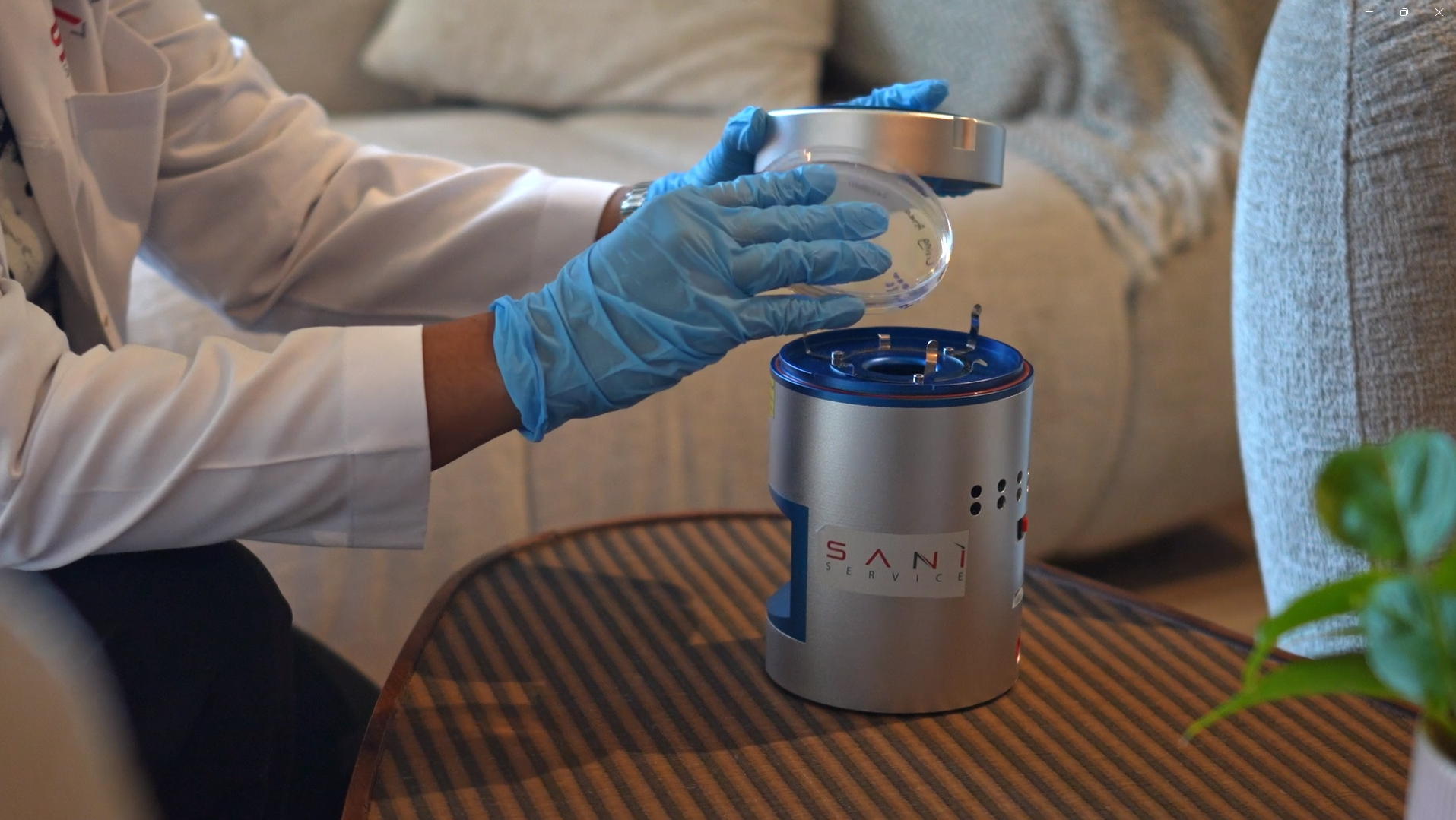
Professional water sampling for microbiological analysis involves sterile collection vessels, sodium thiosulphate neutralisation to halt chlorine activity at the point of collection, appropriate sample volumes matched to the test methods being applied, strict temperature-controlled transport to the laboratory, and analysis initiated within specified holding times. The Indoor Sciences laboratory operated by Saniservice applies these protocols consistently, with results returned in days rather than weeks — a timeline that matters when a potential contamination event is under active investigation.
Sampling points also matter. A single tap result tells one part of the story. A complete assessment samples the tank directly, the first-draw from point-of-use fixtures, and mid-system locations where temperature differentials or flow stagnation are most likely. What microbiological testing reveals in Dubai water changes depending on where in the building the sample is collected.
Common Findings in UAE Building Water Systems
Based on field investigations across residential villas, apartment buildings, and commercial facilities in Dubai and across the UAE, several microbiological findings appear with regularity during laboratory analysis.
Elevated total coliform counts are the most frequently encountered result, most often associated with tanks that have not been cleaned within twelve months, or where cleaning was performed without verified post-disinfection testing. Pseudomonas aeruginosa appears consistently in systems where tank interior surfaces show visible biofilm or slime accumulation — even in buildings where coliform results appear acceptable. This illustrates why a multi-parameter test panel is more informative than a single-indicator approach.
Legionella pneumophila, the organism responsible for Legionnaires’ disease, requires specialist culture methods and extended incubation periods. It is not a routine component of every water test, but it should be included in the assessment of any water system serving buildings with cooling towers, large centralised hot water circuits, or facilities housing vulnerable populations such as schools, clinics, or care facilities. When Legionella testing is included in a water quality assessment, findings in UAE buildings are most commonly associated with water held at intermediate temperatures — between 25°C and 45°C — in poorly circulated sections of hot water distribution systems.
The Relationship Between Tank Condition and Microbial Load
Tank interior condition is the single strongest predictor of microbiological findings during water quality testing in UAE buildings. A tank with intact internal coating, no visible sediment accumulation, functioning inlet and outlet positioning that promotes turnover, and a securely fitted inspection cover will consistently produce lower microbial counts than a tank where any of these variables are compromised.
Sediment accumulation at the base of water tanks is particularly significant. Sediment forms an oxygen-depleted, nutrient-rich substrate that supports the growth of anaerobic bacteria and protects organisms from the disinfectant action of residual chlorine. Microbiological testing of water drawn from tanks with visible sediment shows characteristically different results from water drawn off the surface of the same tank — an important reason why composite sampling from multiple depths produces a more reliable result than a single surface draw.
Reading Your Laboratory Report Correctly
A microbiological water test report is only useful if it is interpreted against the correct reference standard. The UAE applies water quality standards aligned with WHO Guidelines for Drinking-water Quality, and the UAE Cabinet Resolution and Emirates Authority for Standardisation and Metrology guidelines establish specific limits for potable water parameters.
The critical threshold for E. coli in drinking water is zero — no detectable colony-forming units per 100 ml. For total coliforms, the same absence criterion applies to treated piped water at the point of use. For HPC, acceptable levels vary by context and guideline, but values above 500 colony-forming units per ml consistently indicate microbial proliferation requiring investigation. Pseudomonas aeruginosa should be absent from water intended for drinking, food preparation, or vulnerable populations.
When a report arrives with an exceedance, the appropriate response is not immediate alarm — it is systematic investigation to identify the source, followed by remediation and re-testing to verify resolution.
When Testing Is Most Warranted
Microbiological testing of building water is not only relevant when something is visibly wrong. The cases where testing provides the most actionable information include the following situations.
- After a tank cleaning service, to verify that disinfection achieved the required outcome
- Before occupancy of a newly fitted-out property, where plumbing has been dormant for extended periods
- Following renovation work that involved the water supply system
- When residents report persistent gastrointestinal illness, unusual taste, or odour changes in tap water
- As part of annual building hygiene compliance documentation for commercial properties
- In buildings housing children under five, elderly residents, or individuals with compromised immune systems
What microbiological testing reveals in Dubai water is most useful when the results are contextualised with a building inspection — a visual assessment of tank condition, plumbing age, and system configuration that helps explain why the laboratory numbers are what they are.
Key Takeaways for Property Owners and Managers
- Treated municipal supply does not remain sterile once it enters building storage — tank and plumbing conditions drive microbial outcomes
- Dubai’s summer temperatures accelerate chlorine dissipation and bacterial growth in rooftop tanks
- A complete microbiological test panel includes total coliforms, E. coli, HPC, and Pseudomonas aeruginosa at minimum
- Sample point selection across the distribution loop produces more reliable results than a single tap sample
- Annual microbiological testing aligned with tank cleaning provides a documented baseline and supports early detection
- Laboratory results require interpretation against UAE-applicable standards, not generic international benchmarks from different climate contexts
Conclusion
What microbiological testing reveals in Dubai water is ultimately a picture of how a building interacts with its water supply — not just a set of numbers on a laboratory report. The organisms detected, their concentrations, and their distribution across sampling points tell a story about tank maintenance history, plumbing configuration, temperature conditions, and the adequacy of disinfection practices. In a climate as demanding as the UAE’s, where summer heat and tank-dependent supply create consistently elevated microbial risk, that story matters to the health of every person drinking, cooking with, or bathing in the building’s water. Commissioning a professional microbiological water assessment through a laboratory with in-house testing capability — and acting on what the results show — is how building owners and managers convert that story from a risk into a resolved condition.
Frequently Asked Questions
What does microbiological water testing in Dubai typically measure?
A standard microbiological water test in Dubai measures total coliform bacteria, Escherichia coli, heterotrophic plate count, and Pseudomonas aeruginosa. Legionella testing is added for systems serving vulnerable populations or buildings with cooling towers. Each parameter targets a different aspect of microbial risk within the UAE building water supply chain.
How does Dubai’s climate affect the bacteria found in tap water?
Rooftop storage tank temperatures in Dubai regularly exceed 40°C during summer. At these temperatures, residual chlorine dissipates rapidly and bacteria multiply faster than in cooler climates. This means buildings in Dubai face a structurally higher microbial risk in stored water than equivalent buildings in Europe or North America, regardless of municipal supply quality.
Is it normal to find bacteria in Dubai tap water?
Treated municipal supply from DEWA meets strict standards at the point of distribution. However, once water enters building storage tanks, microbial contamination can develop. Findings of elevated total coliforms or Pseudomonas in building water are not unusual during laboratory analysis, particularly in tanks that have not been cleaned and tested within twelve months.
When should a Dubai property get microbiological water testing done?
Testing is most warranted after tank cleaning (to verify disinfection), before occupancy following renovation or fit-out, when residents report taste or odour changes, and annually as part of building hygiene compliance. Properties housing children, elderly residents, or immunocompromised individuals should prioritise regular scheduled testing rather than waiting for visible indicators of a problem.
What happens if E. coli is found in a Dubai building water test?
E. coli detection in drinking water is a zero-tolerance finding under WHO guidelines and UAE-applicable standards. It requires immediate investigation to identify the contamination source — most commonly compromised tank integrity or cross-contamination — followed by disinfection, physical remediation where necessary, and confirmatory re-testing before the water is returned to use.
How is professional water testing different from a basic water test kit?
Professional microbiological analysis uses calibrated culture methods, sterile sampling protocols, temperature-controlled transport, and accredited laboratory procedures that consumer kits cannot replicate. The reliability of the result, the range of organisms detected, and the ability to interpret findings against UAE-applicable standards all depend on laboratory methodology that in-house testing facilities like Saniservice’s Indoor Sciences lab are specifically equipped to provide.
Does water tank cleaning eliminate the need for microbiological testing in UAE buildings?
Cleaning and testing serve different functions and are not interchangeable. Tank cleaning removes sediment and applies disinfectant, but cannot confirm by itself that the desired microbial reduction was achieved. Microbiological testing after cleaning provides the only objective verification that the water meets acceptable standards — without it, a cleaned tank is an assumed outcome rather than a documented one. Understanding What Microbiological Testing Reveals in Dubai Water is key to success in this area.