Air Quality Testing Standards for UAE Buildings Dubai Guide
Air Quality Testing Standards for UAE Buildings differ significantly from temperate climate protocols due to extreme heat, high humidity cycles, and year-round air conditioning dependency. In Dubai’s construction environment, where buildings age rapidly under thermal stress and moisture intrusion patterns follow desert-specific pathways, proper Air Quality Testing Standards for UAE Buildings must incorporate both international protocols and localised adaptations. The core question isn’t whether to test—it’s which standards apply to your specific property type and what the laboratory results actually indicate about your indoor environment.
As an IAC2 Certified Indoor Air Consultant with twelve years of field experience across UAE properties, I’ve observed that most indoor air quality issues stem from predictable building physics failures rather than mysterious contaminants. Proper Air Quality Testing Standards for UAE Buildings help identify these failure points through systematic measurement rather than assumption. This guide examines the key standards, methodologies, and interpretation frameworks that distinguish professional-grade assessment from basic air sampling.
Air Quality Testing Standards for UAE Buildings – International Standards Adapted for UAE Conditions
Air Quality Testing Standards for UAE Buildings typically reference three international frameworks: ISO 16000 series for indoor air measurement, ASHRAE Standard 62.1 for ventilation requirements, and EPA protocols for contaminant sampling. However, direct application without climate adaptation yields misleading results. Dubai’s extreme outdoor conditions create unique indoor environments where relative humidity can swing from 20% to 80% within hours as AC systems cycle, and dust infiltration rates exceed temperate climate benchmarks by factors of 5-10.
Professional implementation of Air Quality Testing Standards for UAE Buildings requires calibration for these conditions. For example, particulate matter (PM2.5/PM10) baselines must account for background desert dust levels that would trigger alerts in European cities but represent normal conditions here. Similarly, VOC sampling protocols must consider off-gassing patterns accelerated by high temperatures and UV exposure through windows.
ASHRAE 62.1 Ventilation Requirements
The ASHRAE 62.1 standard provides minimum ventilation rates for acceptable indoor air quality, but Dubai implementations require additional considerations. The standard assumes certain outdoor air quality conditions that don’t align with desert environments. Professional Air Quality Testing Standards for UAE Buildings incorporate enhanced filtration requirements and pressure balancing tests to ensure ventilation systems don’t introduce more problems than they solve.
Air Quality Testing Standards for UAE Buildings – Dubai Municipality Guidelines for Indoor Air Quality
While not legislated as mandatory standards, Dubai Municipality has published comprehensive guidelines for indoor air quality in commercial and residential buildings. These guidelines complement international Air Quality Testing Standards for UAE Buildings with specific local requirements. They emphasise proper maintenance of HVAC systems, regular cleaning of air handling units, and monitoring of carbon dioxide levels in densely occupied spaces.
The municipality guidelines particularly focus on shopping malls, hotels, and office buildings where occupant density creates unique challenges. Implementation of Air Quality Testing Standards for UAE Buildings in these environments requires additional parameters including airborne bacteria monitoring, humidity control verification, and assessment of fresh air intake quality.
Air Quality Testing Standards for UAE Buildings – Laboratory Analysis Protocols and Methodologies
Proper Air Quality Testing Standards for UAE Buildings require ISO 17025-accredited laboratory analysis for reliable results. The testing process typically involves multiple methodologies: active air sampling for particulate matter, thermal desorption tubes for VOCs, formaldehyde-specific sampling, and microbial culture analysis for biological contaminants. Each method follows strict chain-of-custody protocols from field collection to laboratory reporting.
In Dubai’s environment, we’ve adapted these standard methodologies to account for high background contamination levels. For example, microbial analysis requires extended incubation periods to distinguish between normal desert microbiota and problematic growth. VOC analysis must differentiate between outdoor infiltration from traffic and industrial sources versus indoor off-gassing from building materials.
Parameters Measured in Comprehensive Air Quality Assessment
A complete assessment following Air Quality Testing Standards for UAE Buildings measures multiple parameters simultaneously. Particulate matter (PM2.5 and PM10) indicates filtration efficiency and outdoor air intrusion. Carbon dioxide levels reveal ventilation adequacy and occupant load management. Total volatile organic compounds (TVOCs) and formaldehyde detect chemical off-gassing from materials and furnishings.
Additional parameters specific to Dubai conditions include temperature and humidity mapping to identify thermal bridging issues, carbon monoxide from parking garage infiltration, and ozone levels that can elevate during summer months. Professional implementation of Air Quality Testing Standards for UAE Buildings always includes baseline outdoor measurements to contextualise indoor results.
Testing Equipment and Technology Requirements
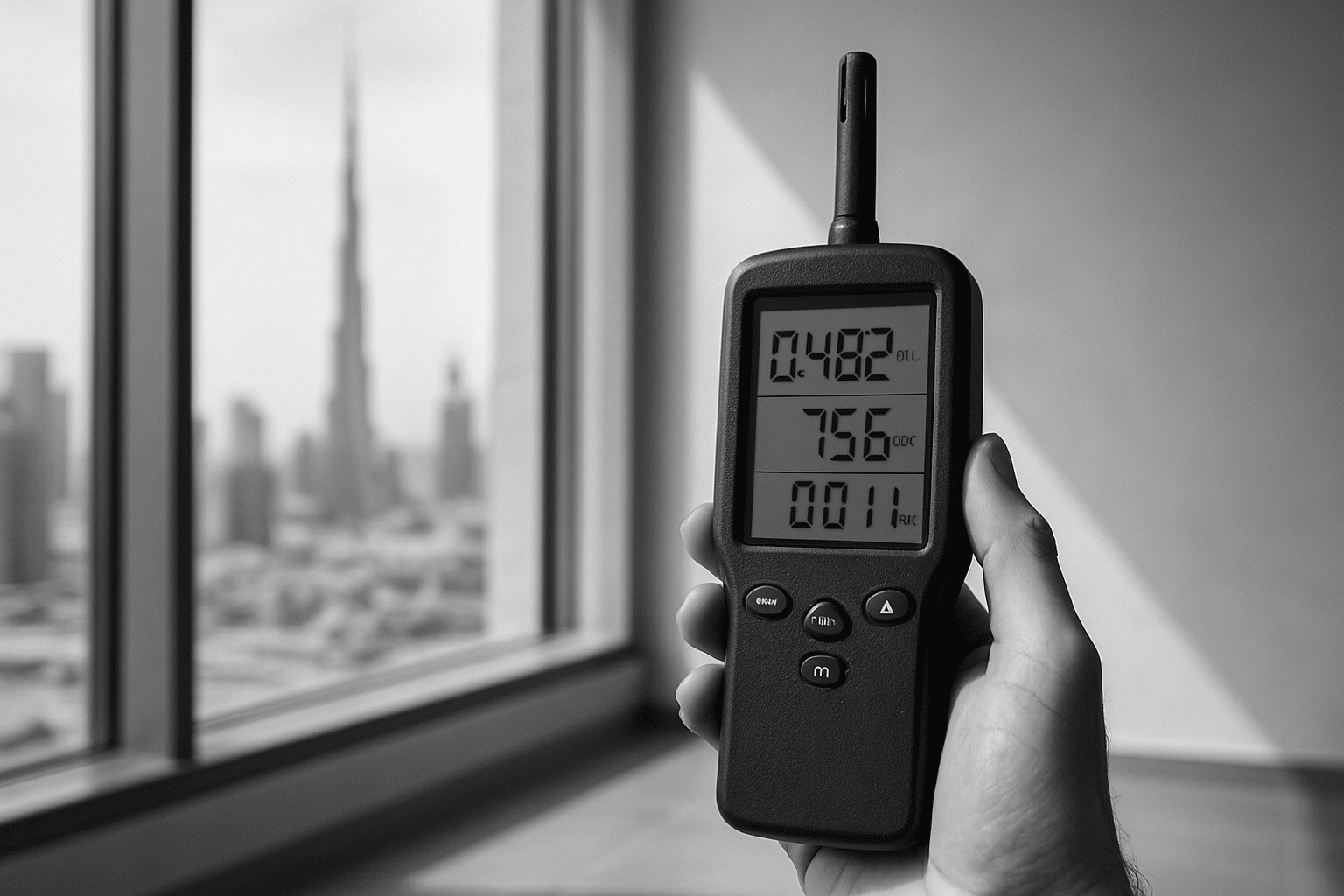
Proper implementation of Air Quality Testing Standards for UAE Buildings requires calibrated, professional-grade equipment rather than consumer devices. Laser particle counters must have certified calibration for desert dust particle sizes. VOC monitors require photoionisation detectors with appropriate lamp energies for desert climate compounds. Humidity and temperature sensors must have rapid response times to capture AC cycling effects.
Beyond basic sensors, advanced Air Quality Testing Standards for UAE Buildings incorporate thermal imaging to identify hidden moisture issues, anemometers to measure air velocity at diffusers, and pressure gauges to assess building pressurisation. These additional tools help identify the root causes of air quality issues rather than just measuring symptoms.
Interpretation Frameworks for Dubai Results
The most critical aspect of Air Quality Testing Standards for UAE Buildings is proper interpretation of results within local context. International guidelines for acceptable contaminant levels often don’t apply directly to Dubai conditions. For example, particulate matter levels that would indicate poor air quality in Europe might represent normal background levels here when proper filtration is functioning.
Professional interpretation frameworks for Air Quality Testing Standards for UAE Buildings consider building age, maintenance history, occupant sensitivity, and outdoor conditions during testing. Rather than comparing results to generic standards, we assess whether the building is performing optimally for its specific design and location. This approach identifies actionable issues rather than creating unnecessary concern over normal desert conditions.
Comparison of Testing Approaches: Baseline vs Investigative
Air Quality Testing Standards for UAE Buildings typically follow two approaches: baseline assessment for general air quality evaluation and investigative testing for specific problem identification. Baseline testing follows standardised protocols with fixed parameters and locations. Investigative testing adapts protocols based on initial findings and may include destructive testing or extended monitoring periods.
For most Dubai properties, we recommend starting with baseline assessment following established Air Quality Testing Standards for UAE Buildings, then progressing to investigative testing if issues are identified. This phased approach ensures cost-effective assessment while maintaining scientific rigor. The table below compares the two approaches:
| Parameter | Baseline Testing | Investigative Testing |
|---|---|---|
| Scope | Standard parameters at fixed locations | Custom parameters based on findings |
| Duration | 4-8 hours typically | 24-72 hours often required |
| Cost | Lower initial investment | Higher due to customisation |
| Best For | Routine assessment | Problem solving |
Actionable Recommendations After Testing
Implementation of Air Quality Testing Standards for UAE Buildings should always conclude with actionable recommendations tailored to the specific property. These typically include HVAC system modifications, filtration upgrades, pressure balancing adjustments, or moisture management strategies. The recommendations should prioritise interventions based on health impact and cost-effectiveness.
For Dubai properties, the most common recommendations involve enhancing filtration to MERV 13 or higher standards, improving humidity control through AC system adjustments, and addressing negative pressure issues that draw in desert dust. Proper implementation of Air Quality Testing Standards for UAE Buildings always includes follow-up verification testing to ensure interventions achieved desired outcomes.
Frequently Asked Questions
How often should air quality testing be conducted in Dubai buildings?
For residential properties, comprehensive air quality assessment following proper Air Quality Testing Standards for UAE Buildings should occur every 2-3 years or after significant renovation. Commercial spaces with high occupant density should undergo annual testing. Properties with sensitive occupants or known issues may require more frequent monitoring.
What makes Dubai’s air quality testing requirements unique?
Dubai’s desert climate, rapid construction patterns, and extreme temperature variations create unique challenges for Air Quality Testing Standards for UAE Buildings. Testing protocols must account for high background dust levels, accelerated off-gassing from materials under heat stress, and moisture intrusion patterns specific to concrete structures in arid environments.
Can I use consumer-grade air quality monitors instead of professional testing?
Consumer devices provide interesting trend data but lack the accuracy and calibration required for proper Air Quality Testing Standards for UAE Buildings. They cannot provide legally defensible results or detect the specific contaminant profiles needed for professional remediation planning. Professional equipment undergoes regular calibration and follows chain-of-custody protocols.
What are the most common air quality issues found in Dubai homes?
Based on field investigations implementing Air Quality Testing Standards for UAE Buildings, the most common issues include inadequate filtration allowing desert dust infiltration, humidity control problems leading to microbial growth in AC systems, VOC off-gassing from new furnishings, and negative pressure drawing contaminants from parking areas or adjacent units.
How long does professional air quality testing take in Dubai?
A comprehensive assessment following Air Quality Testing Standards for UAE Buildings typically requires 4-8 hours on site for sample collection, plus 3-5 days for laboratory analysis. Investigative testing for complex issues may require multiple site visits and extended monitoring periods over several days to capture daily cycles and usage patterns.
Proper implementation of Air Quality Testing Standards for UAE Buildings provides objective data to guide indoor environment improvements. Rather than guessing about air quality issues, professional assessment identifies specific contaminants, quantifies exposure levels, and pinpoints source locations. This evidence-based approach leads to targeted interventions that actually improve indoor air rather than temporary measures that address symptoms rather than causes.
The value of proper Air Quality Testing Standards for UAE Buildings lies not just in identifying problems but in establishing baselines for ongoing monitoring. With professional assessment documentation, property owners can track improvements over time, verify the effectiveness of interventions, and make informed decisions about HVAC upgrades or building modifications. This long-term perspective transforms air quality from a vague concern into a manageable building performance parameter.

JV de Castro, IAC2
JV de Castro is the Chief Technology Officer at Saniservice, where he leads innovation in indoor environmental sciences, IT infrastructure, and digital transformation. With over 20 years of experience spanning architecture, building science, technology management, digital media architecture, and consultancy, he has helped organizations optimize operations through smart solutions and forward-thinking strategies. JV holds a Degree in Architecture, a Masters of Research in Anthropology, an MBA in Digital Communication & Media, along with certifications in mold, building sciences and advanced networking. Passionate about combining technology, health, and sustainability, he continues to drive initiatives that bridge science, IT, and business impact.