Humidity Control Solutions for Dubai Villas Complete Guide
Living in Dubai presents unique challenges when it comes to maintaining comfortable indoor environments, particularly regarding Humidity Control Solutions for Dubai villas. The extreme desert climate, combined with constant air conditioning use, creates perfect conditions for humidity problems that can affect both your property’s structural integrity and your family’s health. As someone who has spent over a decade developing indoor environmental solutions specifically for UAE conditions, I’ve witnessed firsthand how improper humidity management leads to mold growth, structural damage, and health concerns in even the most luxurious Dubai villas.
The quest for effective humidity control solutions for Dubai villas requires understanding both the climate challenges and the architectural characteristics of local construction. Dubai’s combination of high outdoor temperatures and indoor cooling creates significant condensation issues, while the rapid construction methods often used in the region can leave vulnerabilities in building envelopes. Through our extensive work with villa owners across Emirates Hills, Palm Jumeirah, and other premium communities, we’ve developed proven strategies that address these unique challenges.
This comprehensive guide will explore seven essential humidity control solutions for Dubai villas, drawing from both scientific principles and practical field experience. Whether you’re dealing with persistent musty odours, visible condensation, or concerned about hidden mold growth, these strategies will help you create a healthier, more comfortable living environment while protecting your property investment.
Humidity Control Solutions For Dubai Villas – Understanding Dubai’s Unique Humidity Challenges
Effective humidity control solutions for Dubai villas must begin with understanding the specific environmental factors at play. Dubai’s climate creates a paradoxical situation where outdoor air may have low absolute humidity, but when this air enters cooled indoor spaces, the relative humidity skyrockets. This phenomenon occurs because cooler air cannot hold as much moisture, causing relative humidity levels to increase dramatically even when minimal moisture is present.
The architectural design of many Dubai villas compounds these challenges. Large glass facades, common in modern villa designs, create significant thermal bridging and condensation surfaces. Construction methods that prioritise speed over moisture management often leave gaps in vapour barriers and insufficient insulation at critical junctions. We frequently encounter villas where the wall-floor interface becomes a condensation point, hidden behind skirting boards where mold can develop undetected for years.
Another critical factor is the behavioural patterns of villa occupants. The tendency to keep windows closed year-round to maintain cooling efficiency creates stagnant air conditions where moisture accumulates. Activities like cooking, showering, and even breathing add significant moisture to the indoor environment without adequate ventilation to remove it. Understanding these interconnected factors is essential for developing comprehensive humidity control solutions for Dubai villas that address both the physical infrastructure and occupant behaviours.
Humidity Control Solutions For Dubai Villas: Smart HVAC System Solutions
Your HVAC system represents the first line of defence in humidity control solutions for Dubai villas. Traditional systems often focus solely on temperature control, but modern smart systems can actively manage humidity levels. Variable refrigerant flow (VRF) systems and inverter technology allow for more precise control of cooling cycles, which is crucial for effective dehumidification. Standard systems that short-cycle (turn on and off frequently) cool the air without adequately removing moisture, creating that familiar cold-but-damp feeling.
We recommend villa owners consider HVAC systems with dedicated dehumidification modes or add-on desiccant systems. These systems work by passing air over cold coils that condense moisture out of the air, effectively lowering humidity levels independent of temperature control. For larger villas (typically 4,000 square feet and above), multiple-zoned systems allow different areas to be controlled separately based on their specific humidity challenges. Bedrooms might require different settings than living areas or bathrooms, and zoned systems accommodate these variations.
Regular maintenance is equally crucial for HVAC performance in humidity control solutions for Dubai villas. Dirty coils reduce system efficiency and can become breeding grounds for mold that then distributes spores throughout your home. We recommend professional cleaning every six months, with filter changes every three months during peak cooling season. Investing approximately AED 1,200-2,000 annually in professional HVAC maintenance can prevent humidity problems that might cost tens of thousands to remediate later.
Humidity Control Solutions For Dubai Villas: Dedicated Dehumidification Systems
For comprehensive humidity control solutions for Dubai villas, dedicated whole-house dehumidification systems often provide the most effective results. These systems work independently of your HVAC to maintain optimal humidity levels (40-60% relative humidity) regardless of temperature settings. Unlike portable units that only address single rooms, whole-house systems integrate with your existing ductwork to treat the entire villa consistently.
There are two primary types of whole-house dehumidifiers suitable for Dubai villas: refrigerant-based and desiccant-based systems. Refrigerant models work similarly to air conditioners by cooling air to condense moisture, making them energy-efficient in our climate. Desiccant systems use moisture-absorbing wheels and are particularly effective in cooler conditions or where very low humidity levels are required. Installation costs typically range from AED 8,000-15,000 depending on villa size and system complexity, with operating costs adding approximately AED 200-400 monthly to electricity bills.
We’ve installed these systems in numerous Dubai villas with remarkable results. One case in a Jumeirah villa reduced humidity from consistently above 70% to a stable 45%, eliminating musty odours and resolving chronic allergy symptoms the family had experienced for years. The system paid for itself within eighteen months by allowing them to set their AC temperature 2-3 degrees higher while maintaining comfort through better humidity control, resulting in significant energy savings.
Advanced Ventilation Strategies
Proper ventilation forms a critical component of effective humidity control solutions for Dubai villas. While opening windows might seem counterintuitive in our climate, strategic ventilation at appropriate times can significantly reduce indoor humidity levels. The key is understanding when outdoor conditions are favourable for natural dehumidification – typically during early morning hours when dew points are lowest.
Energy recovery ventilation (ERV) systems offer a sophisticated solution for maintaining fresh air without compromising humidity control. These systems exchange indoor and outdoor air while transferring humidity and temperature between the two streams. In summer, outgoing cool, dry air pre-cools and dehumidifies incoming hot, humid air. In winter, the process works in reverse. Installation costs for whole-house ERV systems typically range from AED 12,000-25,000 depending on villa size and complexity.
For spot ventilation in high-moisture areas, we recommend installing exhaust fans with humidity sensors in bathrooms, kitchens, and laundry rooms. These fans automatically activate when humidity levels rise above set points, removing moisture at its source before it can spread through your villa. Modern models operate at noise levels below 1.0 sones, making them virtually silent during operation. Combining strategic natural ventilation with mechanical systems creates comprehensive humidity control solutions for Dubai villas that address both whole-house and localized moisture issues.
Building Envelope Improvements
The physical structure of your villa plays a fundamental role in humidity control solutions for Dubai villas. Gaps, cracks, and insufficient insulation in the building envelope allow moisture-laden air to infiltrate, creating condensation points where cooler interior surfaces meet warmer humid air. Thermal imaging assessments we’ve conducted across hundreds of Dubai villas consistently reveal hidden leakage points at window frames, door seals, and structural junctions.
Improving insulation represents one of the most effective upgrades for humidity control. Spray foam insulation provides both thermal resistance and an air barrier, reducing both heat transfer and moisture infiltration. For existing villas, injection foam can be installed in wall cavities without major demolition. Window upgrades to double or triple glazing with thermal breaks significantly reduce condensation on glass surfaces, which is a common problem in Dubai’s climate where temperature differentials between indoors and outdoors can exceed 20°C.
Vapor barrier installation is another critical consideration in humidity control solutions for Dubai villas. Properly installed vapor barriers on the warm side of insulation (exterior in cooling-dominated climates) prevent moist outdoor air from reaching cool interior surfaces where condensation occurs. We often discover that vapor barriers in Dubai villas were either omitted during construction or installed incorrectly, leading to chronic humidity problems. Remedying these issues typically costs AED 15,000-30,000 for a medium-sized villa but provides permanent solutions to infiltration-related humidity problems.
Moisture Source Control Measures
Preventing moisture at its source represents the most cost-effective approach among humidity control solutions for Dubai villas. Indoor moisture originates from various activities and systems, each requiring specific management strategies. Cooking generates significant moisture – boiling a large pot of water can release over 1 litre of moisture into your indoor air. Using exhaust hoods that vent outdoors (not recirculating models) during all cooking activities is essential.
Bathing and showering represent another major moisture source. A single shower can add 0.5 litres of moisture to your indoor environment. Installing timer-controlled exhaust fans that run for 20-30 minutes after showering ensures moisture is removed effectively. For luxury villas with multiple bathrooms, centralised exhaust systems with humidity sensors provide automated control. We also recommend showering with bathroom doors closed to prevent moisture spreading to other areas.
Indoor plants, aquariums, and even drying clothes indoors contribute significantly to humidity levels. While plants offer aesthetic and air quality benefits, limiting them to reasonable numbers and ensuring proper drainage helps control moisture release. For laundry, using condenser dryers that collect moisture in tanks rather than venting it indoors, or ensuring traditional dryers vent completely outdoors, prevents adding litres of moisture to your indoor air daily. These behavioural adjustments complement mechanical systems in comprehensive humidity control solutions for Dubai villas.
Humidity Monitoring Technology
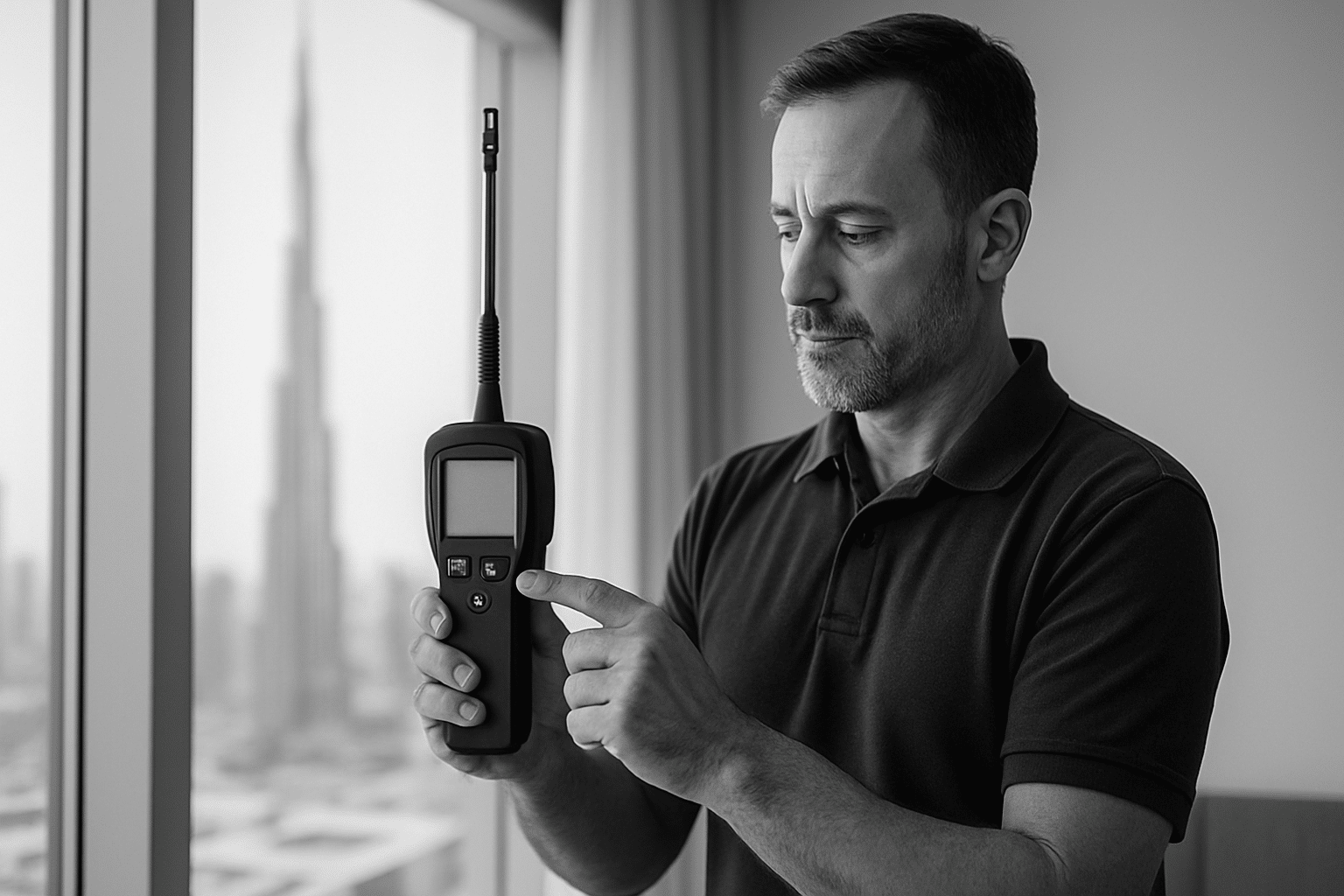
Effective management requires measurement, making monitoring technology essential for humidity control solutions for Dubai villas. Basic hygrometers costing AED 100-300 provide spot measurements, but smart monitoring systems offer comprehensive visibility into your villa’s humidity patterns. Wireless sensor networks allow you to monitor conditions in multiple rooms simultaneously, identifying problem areas before they develop into major issues.
Advanced systems like those we install in Dubai villas include data logging capabilities that track humidity levels over time, correlating them with temperature, outdoor conditions, and household activities. This data reveals patterns – perhaps humidity spikes consistently during certain times of day or in specific weather conditions – enabling targeted interventions. These systems typically cost AED 2,000-5,000 installed, with monthly monitoring services adding AED 200-400 for professional analysis and alerting.
Integration with smart home systems represents the cutting edge of humidity control solutions for Dubai villas. Systems that connect humidity sensors with your HVAC, dehumidifiers, and ventilation equipment enable automated responses to changing conditions. When humidity rises above set points, the system can activate dehumidification modes, adjust ventilation rates, or send alerts to your smartphone. This proactive approach prevents problems rather than reacting to them, maintaining optimal conditions consistently throughout your villa.
Expert Implementation Tips
Based on twelve years of implementing humidity control solutions for Dubai villas, I’ve compiled these essential tips for successful humidity management. First, conduct a comprehensive assessment before investing in equipment. Thermal imaging and moisture mapping often reveal specific problem areas that require targeted solutions rather than whole-house systems. This assessment typically costs AED 1,500-2,500 but can save tens of thousands in unnecessary equipment purchases.
Prioritise building envelope improvements before mechanical systems. Sealing air leaks and improving insulation reduces the moisture load your mechanical systems must handle, allowing smaller, more efficient equipment to maintain optimal conditions. We typically recommend addressing envelope issues first, then reassessing humidity levels before selecting mechanical systems. This sequential approach often reduces both equipment costs and operating expenses.
Consider professional humidity mapping to understand moisture movement patterns within your villa. Using tracer gases and sophisticated monitoring equipment, we can identify how air moves between rooms, where moisture accumulates, and how external conditions affect indoor humidity. This service typically costs AED 3,000-5,000 but provides invaluable data for designing truly effective humidity control solutions for Dubai villas tailored to your specific property and lifestyle.
Frequently Asked Questions
What is the ideal humidity level for Dubai villas?
The optimal indoor humidity range for Dubai villas is 40-60% relative humidity. Below 40% can cause dry skin and respiratory irritation, while above 60% creates conditions conducive to mold growth and dust mites. Maintaining this range requires careful balancing of ventilation, dehumidification, and temperature control specific to Dubai’s climate challenges.
How much do whole-house dehumidification systems cost in Dubai?
Professional installation of whole-house dehumidification systems in Dubai villas typically ranges from AED 8,000-25,000 depending on villa size, system type, and complexity of installation. Operating costs add approximately AED 200-600 monthly to electricity bills, though energy-efficient models can reduce this significantly. The investment often pays for itself through improved comfort and prevention of moisture-related damage.
Can humidity problems affect villa structural integrity?
Yes, chronic high humidity can significantly impact structural integrity through wood rot, metal corrosion, and concrete degradation. We’ve documented cases where persistent humidity issues led to structural beam damage requiring extensive repairs costing AED 50,000-100,000. Proper humidity control represents not just a comfort issue but a critical property protection measure.
Implementing comprehensive humidity control solutions for Dubai villas requires understanding both the unique climate challenges and the specific architectural characteristics of local construction. By combining strategic building improvements with appropriate mechanical systems and smart monitoring technology, villa owners can create healthy, comfortable indoor environments while protecting their property investments. The solutions outlined here represent proven approaches developed through extensive field experience across Dubai’s diverse villa landscape.

JV de Castro, IAC2
JV de Castro is the Chief Technology Officer at Saniservice, where he leads innovation in indoor environmental sciences, IT infrastructure, and digital transformation. With over 20 years of experience spanning architecture, building science, technology management, digital media architecture, and consultancy, he has helped organizations optimize operations through smart solutions and forward-thinking strategies. JV holds a Degree in Architecture, a Masters of Research in Anthropology, an MBA in Digital Communication & Media, along with certifications in mold, building sciences and advanced networking. Passionate about combining technology, health, and sustainability, he continues to drive initiatives that bridge science, IT, and business impact.