The Best Air Purifier in Dubai for Homes
Which Is the Best Air Purifier in Dubai for Homes? The answer lies not in a single product recommendation but in matching filtration technology to your home’s specific contamination profile. Dubai’s climate—characterised by extreme heat, high humidity outdoors, and complete air conditioning dependency indoors—creates unique indoor air quality challenges that generic consumer purifiers often fail to address effectively. The best solution emerges from understanding what contaminants are actually present in your living space, measured through professional assessment rather than assumed from marketing claims.
As an IAC2 Certified Indoor Air Consultant with over a decade of field experience in UAE residences, I’ve documented how Dubai’s building environment differs fundamentally from European or American contexts. Our in-house laboratory in Al Quoz consistently identifies thermophilic mould species, fine desert silica dust, and VOC off-gassing patterns that require targeted filtration approaches. Which Is the Best Air Purifier in Dubai for Homes? becomes a scientific question answered through measurement before recommendation.
The Best Air Purifier in Dubai for Homes – Understanding Dubai’s Unique Indoor Air Quality Challenges
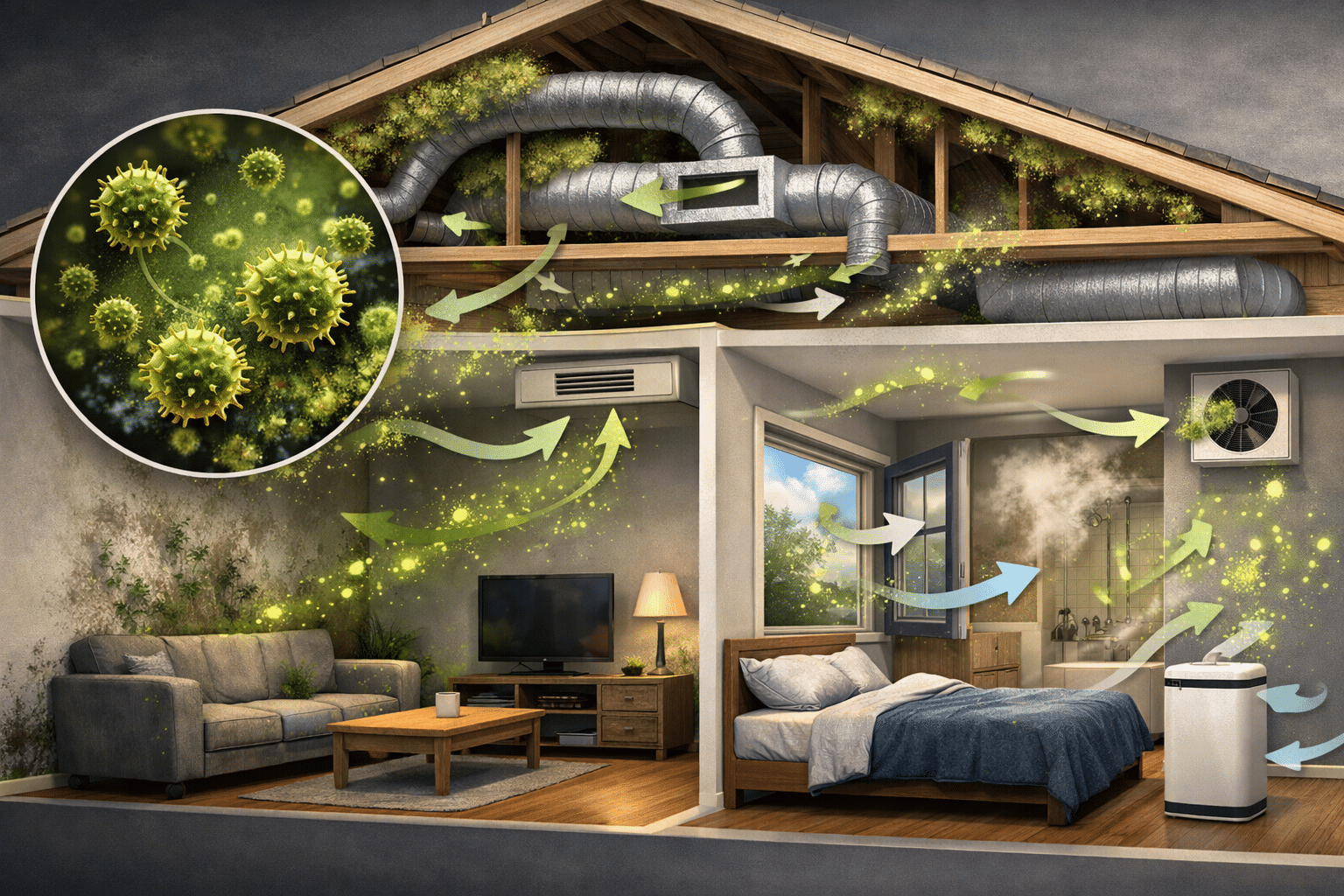
Which Is the Best Air Purifier in Dubai for Homes? begins with recognising the environmental factors that shape indoor contamination. Dubai’s desert climate creates a paradox: extremely dry outdoor air but humidity-controlled indoor environments that often harbour moisture-related issues. Air conditioning systems running continuously recirculate air through ductwork that frequently contains microbial growth, dust accumulation, and particulate matter from construction activity.
During thermal imaging assessments of Dubai villas and apartments, we consistently identify thermal bridging and condensation points that create ideal conditions for xerophilic mould species—organisms that thrive in the moderate humidity levels maintained by AC systems. These species differ from the water-damage moulds common in temperate climates, requiring different filtration approaches. Additionally, fine desert sand particles (under 2.5 microns) penetrate building envelopes and HVAC systems, contributing to respiratory irritants that standard filters may not capture effectively.
Common Contaminants in Dubai Homes
Laboratory analysis from our Indoor Sciences division reveals consistent patterns across UAE residences. Thermophilic aspergillus and penicillium species dominate microbial profiles, while VOC testing frequently detects elevated formaldehyde levels from building materials and furniture off-gassing in temperature-controlled environments. Particle counting identifies fine particulate matter (PM2.5) at concentrations that exceed WHO guidelines in many homes without adequate filtration.
Key Factors Determining Which Is the Best Air Purifier in Dubai for Homes
Which Is the Best Air Purifier in Dubai for Homes? depends on several critical factors that go beyond marketing claims and consumer reviews. The first consideration is filtration technology matching—understanding what specific contaminants need addressing in your living space. A purifier effective against pollen may be inadequate for Dubai’s fine silica dust or microbial fragments.
Room size and air exchange rates fundamentally impact purifier effectiveness. Dubai’s open-plan villa layouts require different calculations than compact apartment bedrooms. We recommend CADR (Clean Air Delivery Rate) assessments based on actual room volumes rather than manufacturer estimates. Additionally, HVAC integration considerations are crucial—many modern Dubai homes benefit from whole-house purification systems integrated with existing AC ductwork rather than standalone units.
The Best Air Purifier in Dubai for Homes – Filtration Technologies: What Actually Works in Dubai Condit
Which Is the Best Air Purifier in Dubai for Homes? requires understanding filtration mechanisms proven effective against locally prevalent contaminants. True HEPA filtration remains the gold standard for particulate matter, but not all HEPA filters are equal. We recommend H13 or H14 classification filters that capture 99.95-99.995% of particles down to 0.3 microns—essential for Dubai’s fine desert dust.
Activated carbon filtration proves crucial for VOC reduction, particularly important given the off-gassing from new construction materials and furniture common in Dubai’s rapidly developed properties. For microbial control, UV-C technology can be effective but requires proper wavelength calibration and exposure time—many consumer units lack the specifications needed for actual pathogen inactivation. Photocatalytic oxidation systems show promise but require careful evaluation due to potential ozone generation concerns.
Room-by-Room Considerations for Dubai Homes
Which Is the Best Air Purifier in Dubai for Homes? varies significantly by room function and usage patterns. Master bedrooms often require ultra-quiet operation with emphasis on allergen reduction, particularly given the extended exposure during sleep hours. Living areas with high foot traffic need higher CADR ratings and broader air circulation patterns to handle particle disturbance from movement.
Children’s rooms and nurseries demand special consideration for noise levels and safety features, with emphasis on fine particulate reduction for developing respiratory systems. Kitchen areas benefit from enhanced carbon filtration for cooking-related VOCs and particulate matter. Our field assessments frequently identify kitchen areas as VOC hotspots in Dubai homes due to limited ventilation and high cooking activity.
The Professional Assessment Approach to Purifier Selection
Which Is the Best Air Purifier in Dubai for Homes? should be determined through professional indoor air quality assessment rather than guesswork. Our standard assessment protocol includes particle counting, VOC sampling, microbial air sampling, and thermal imaging to identify contamination sources and concentrations. This data-driven approach eliminates the trial-and-error process of consumer purifier selection.
Laboratory analysis provides the contamination profile that dictates filtration requirements. A home with elevated mould spore counts requires different technology than one with primary VOC concerns. We develop customised purification recommendations based on actual measurement data rather than marketing claims, ensuring homeowners invest in technology that actually addresses their specific air quality issues.
Maintenance and Operational Considerations in Dubai
Which Is the Best Air Purifier in Dubai for Homes? must include consideration of maintenance requirements in local conditions. Dubai’s high particulate loads mean filters require more frequent replacement than manufacturer recommendations based on European or American environments. Our monitoring shows HEPA filters in Dubai homes typically require replacement every 6-8 months rather than the 12-month cycles suggested for cleaner environments.
Energy consumption becomes significant given continuous operation requirements in Dubai’s climate. We recommend energy efficiency verification and calculation of operating costs before purchase. Noise levels prove particularly important in bedroom applications where continuous operation is desired but sleep disruption must be avoided. Digital monitoring and smart home integration capabilities enhance usability but should not override core filtration performance.
Whole-House vs Portable Systems: Dubai Considerations
Which Is the Best Air Purifier in Dubai for Homes? involves deciding between whole-house systems integrated with HVAC versus portable units. Whole-house purification provides comprehensive coverage and operates seamlessly with existing AC systems, particularly advantageous for Dubai’s villa properties with central air conditioning. These systems typically offer higher capacity and better overall air quality management.
Portable units provide flexibility and targeted room protection, often at lower initial investment. They prove effective for apartment living or addressing specific problem areas identified through professional assessment. However, multiple units may be required for complete home coverage, increasing operational costs and maintenance requirements. Our recommendation typically depends on the property type, existing HVAC system, and contamination profile identified during assessment.
Cost Considerations and Value Assessment
Which Is the Best Air Purifier in Dubai for Homes? involves understanding total cost of ownership rather than just purchase price. Initial investment ranges significantly based on technology type and coverage area, but operational costs including filter replacements, energy consumption, and maintenance often exceed initial purchase price over the system lifespan.
We recommend calculating cost per cubic metre of cleaned air over a 3-5 year period rather than comparing initial purchase prices. Higher-quality systems typically offer lower long-term costs despite higher initial investment. Additionally, health and wellbeing benefits should be factored into value assessment—improved sleep quality, reduced respiratory symptoms, and overall comfort improvements represent significant value beyond mere financial calculations.
Professional Installation and Verification
Which Is the Best Air Purifier in Dubai for Homes? often involves professional installation for optimal performance. Whole-house systems require HVAC integration by qualified technicians to ensure proper airflow maintenance and system compatibility. Even portable units benefit from professional placement consultation to avoid airflow obstruction and ensure optimal room circulation.
Post-installation verification through particle counting and air quality monitoring ensures the system performs as expected. We frequently identify improperly installed systems that fail to achieve advertised performance levels due to placement issues or configuration errors. Professional verification provides confidence that the investment delivers actual air quality improvements rather than assumed benefits.
Frequently Asked Questions
How often should air purifier filters be replaced in Dubai homes?
Filter replacement frequency in Dubai typically exceeds manufacturer recommendations due to higher particulate loads. HEPA filters generally require replacement every 6-8 months, while carbon filters may need changing every 3-4 months depending on VOC levels. Professional monitoring determines optimal replacement schedules based on actual usage and contamination levels.
Can air purifiers help with Dubai’s desert dust problems?
Quality HEPA filtration systems effectively capture fine desert dust particles that penetrate homes. However, whole-house solutions with proper HVAC integration typically prove more effective than portable units for comprehensive dust control. Professional assessment identifies dust entry points and recommends complementary sealing measures alongside purification.
Are ozone-generating air purifiers safe for Dubai homes?
Ozone-generating purifiers are not recommended for residential use in Dubai or any indoor environment. Ozone poses respiratory health risks and can react with other compounds to form harmful secondary pollutants. We recommend ozone-free technologies that have been independently verified for safety and efficacy.
How do I know if my Dubai home needs an air purifier?
Professional indoor air quality assessment provides definitive answers through particle counting, VOC testing, and microbial sampling. Observable indicators include persistent dust accumulation, musty odours, allergy symptoms that improve when away from home, and visible mould growth. However, many air quality issues remain undetectable without professional measurement.
What size air purifier do I need for my Dubai villa?
Villa purification requirements depend on total volume, room layout, and HVAC system configuration. We calculate requirements based on air exchange rates, contamination levels, and occupancy patterns. Whole-house systems typically recommended for villas require professional sizing based on comprehensive assessment rather than generic room size calculations.
Conclusion: Making an Informed Decision
Which Is the Best Air Purifier in Dubai for Homes? ultimately depends on your specific indoor environment, contamination profile, and living patterns. Rather than seeking a one-size-fits-all solution, we recommend beginning with professional assessment to identify what actually requires filtration in your living space. The investment in understanding your air quality challenges ensures subsequent purification investments deliver actual benefits rather than assumed improvements.
The Dubai environment presents unique challenges that demand tailored solutions. From fine desert dust to AC-recirculated contaminants, the optimal approach combines professional measurement with technology matching. When the time is right for addressing your home’s air quality, beginning with assessment rather than product selection ensures your investment delivers measurable improvement to your indoor wellbeing. Understanding The Best Air Purifier in Dubai for Homes is key to success in this area.

JV de Castro, IAC2
JV de Castro is the Chief Technology Officer at Saniservice, where he leads innovation in indoor environmental sciences, IT infrastructure, and digital transformation. With over 20 years of experience spanning architecture, building science, technology management, digital media architecture, and consultancy, he has helped organizations optimize operations through smart solutions and forward-thinking strategies. JV holds a Degree in Architecture, a Masters of Research in Anthropology, an MBA in Digital Communication & Media, along with certifications in mold, building sciences and advanced networking. Passionate about combining technology, health, and sustainability, he continues to drive initiatives that bridge science, IT, and business impact.