Mold Remediation · specified before the work · verified by measurement after it

Remediation, specified and verified.

Indoor Sciences does not remove mold. It defines what removal must achieve, and confirms afterwards that it did. For the work itself, Saniservice's mold team is on 800-MOLDS.

In the right orderEvery time
  1. The inspection, firstby our Indoor Sciences team
  2. ContainmentHEPA-filtered negative pressure
  3. Removal and treatmentto ANSI/IICRC S520-2024
  4. Drying, and the causewhat fed it, corrected
  5. Verificationmeasured, not assumed
Prescribed by Indoor Sciences, executed by Saniservice, verified by the Saniservice Department of Microbiology.Find · Contain · Remove · Verify

What to expect from remediation.

What you get

The scope and the pass marks, written before the work is priced. The work itself, by the Saniservice mold remediation team, contained and done to the standard. Afterwards, a verification report that says, location by location, whether it passed.

How long

Most remediations are done in a day; a large project takes several. The verification visit follows the work. Cultures need several days to grow, and the report follows within six working days of the visit.

Who

The Saniservice mold remediation team, the first IAC2-certified mold team in the UAE, working to ANSI/IICRC S520-2024. The verification is done by people who did not do the work.

Spreading, or a lot of it?

Call the mold line, 800-MOLDS, 8am to 6pm, and we'll prioritize the inspection: when growth covers more than about one square meter or is moving from room to room, or when a child, an elderly person or someone with a weakened immune system is living with visible growth.

Where to start

Take a breath. Then tell us what you've got.

You have

  • An Indoor Sciences inspection report. The scope is already written. Saniservice prices the work against it and books the team.
  • Mold, and no report yet. The inspection comes first, always, and always by our Indoor Sciences team. It finds the water, names what is growing and where, and writes the scope that the work is priced against. That is a Mold Inspection.
  • Mold that was removed, and nothing measured since. A verification on its own, measured against the scope that was written, or against the standard if there wasn't one.
  • A clearance certificate, and a reason to doubt it. A verification on its own. It is the same measurement whoever signed the certificate.

Any of the four is enough to start. You don't need to know which one you are; tell us what happened and we'll tell you.

Something else

A building under management, a portfolio, or a program over timeAdvisory, where supervision of the work is part of the service.

Air that feels wrong, and no mold in sightAir Quality Testing

How the work is done

In the right order, every time.

Two things have to be true for mold not to come back. The surface has to be dry and stay dry: no leak reaching it, no condensation on it, no air against it humid enough to feed growth. And the material that was colonized has to have been dealt with to a defined standard. Everything below exists to make both true. The verification confirms the second, and checks the first on the day.

The inspection, first

Every remediation starts with an inspection, and every inspection is done by our Indoor Sciences team. It finds the water, names what is growing and where, and writes the scope: what comes out, what gets treated, what has to read dry, and what the air has to read when the work is done. Those pass marks go on paper before anyone prices the job.

Containment

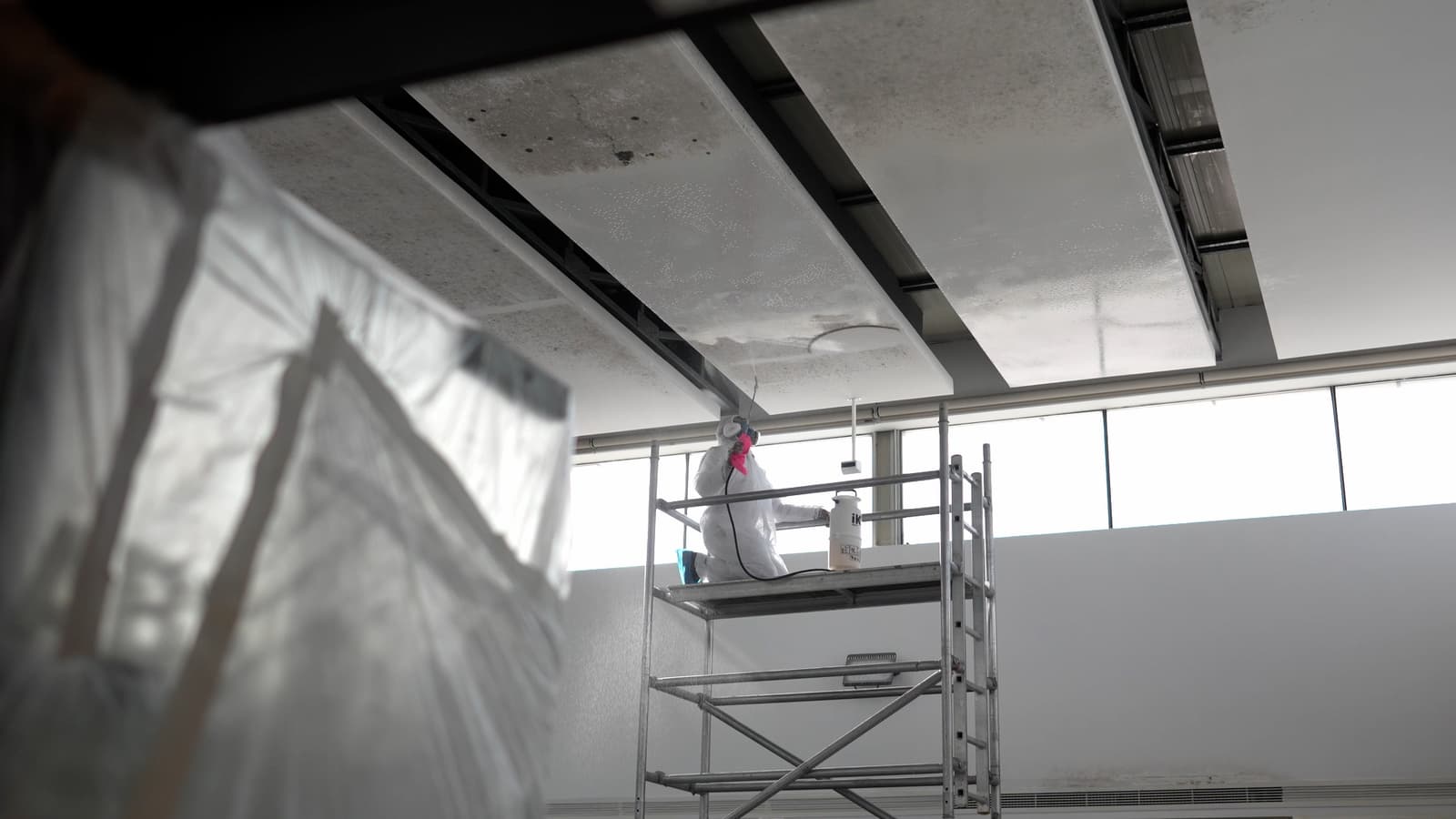
The affected area is sealed with barriers and held under HEPA-filtered negative pressure, with air scrubbers running, so nothing travels to the rest of the building while the Saniservice mold remediation team does the work.

Removal and treatment

Colonized material that the standard says cannot be cleaned is removed, not salvaged. What stays is cleaned and treated with targeted, low-chemical agents, with a non-chemical option.

Drying, and the cause

Industrial drying takes out the moisture that is left. Where the water came from the air-conditioning, condensation or humidity, correcting it is part of Saniservice's work. Where it came from a leak, that repair comes first and belongs to a plumber; the inspection report says exactly where.

Verification

Then the building is measured again, by the same methods and read the same way, against the pass marks written before the work began. By people who did not do the work, and reported separately.

If a location fails

If a location does not meet its pass mark, the report says which one, on which measurement. Locations that pass are recorded as passed; the clearance itself is not issued until every location in the scope does. Where Saniservice carried out the work and the failure is in that work, Saniservice comes back and puts it right at no charge, and the location is verified again. Where the failure is water that has come back, the report says so: that is a repair before it is a re-clean, and the report tells you exactly where.

The team

Mold is a building problem. Saniservice LLC brings the whole team.

Mold sits where moisture, materials and air movement meet, which is why a single trade rarely solves it. The people who inspect, the people who remove and the people who verify all work within Saniservice LLC, under one roof. The corrective work itself is booked with Saniservice: call the mold line, 800-MOLDS, or see the mold remediation team on saniservice.com.

  • The first IAC2-certified mold team in the UAEWorking to ANSI/IICRC S520-2024, the international standard for mold remediation, not improvised methods.
  • Scientists on the jobMicrobiologists and building scientists, HVAC engineers, and certified remediation specialists: one team built for all three sides of the problem.
  • Contained, alwaysBarriers, HEPA-filtered negative pressure and air scrubbers on every job, so the work never spreads the problem.
  • Gentle on an occupied homeTargeted, low-chemical treatment, with a non-chemical option.
  • Usually one dayMost remediations are completed in a day. Large projects take several, and you are told which before the work is priced.
  • Measured, not assumedThe result is measured by people who did not do the work and written up in a report you can hand to a landlord, an insurer or a building manager.
  • Since 2009Homes, offices and commercial buildings across the UAE.
What "passed" means

"Passed" is a measurement, not an opinion.

Every location in the scope is measured, and the report prints each reading beside the mark it is read against.

CheckWhat passesRead against
Visual, room by roomNo growth to be seen, no dust or debris left behind by the work, and the containment taken down cleanly.DM TG 142 Appendix 3 (post-remediation visual inspection) · S520 Condition 1
Moisture in the materialsThe materials that were wet now read at or below the dry limit printed in the inspection report. Our reports use 12% for gypsum and timber, stricter than the 16–18% Dubai Municipality allows. And the moisture source named in the report has been repaired.DM TG 142 §9-1 (≤ 16–18% moisture content) · the inspection report's own dry limit
Surface samplesSterile swabs from the treated surfaces, cultured in the laboratory. A surface passes when nothing grows on it beyond what settles on any clean indoor surface.ANSI/IICRC S520-2024, Conditions 1, 2 and 3
Air sampling for mold sporesBelow the Dubai Municipality guideline of 500 CFU/m³ (TG 119), a count of living mold per cubic meter of air, and no higher than the air outside and in an unaffected room sampled the same day.DM TG 119 Table 2 · DM TG 142 §9
The Moldiness ProfileWhere a profile was taken before the work, the same surfaces are sampled again and the two maps are compared.the baseline, location by location

Every culture sample is grown and read in the Saniservice Department of Microbiology and reported location by location. Where a clearance result must carry formal accreditation, the samples are analyzed by the practice's EIAC-accredited (ISO/IEC 17025) partner laboratory and the report says so. Where the clearance is to be submitted to Dubai Municipality, TG 142 requires the samples to be analyzed by an EIAC-accredited laboratory; we route them to the EIAC-accredited (ISO/IEC 17025) partner laboratory and the report says so.

The Saniservice Department of Microbiology is a working laboratory, not a certifying body. It is run in-house by our microbiologists to recognized methods and documented protocols, and is used to diagnose, to guide the work and to verify results in context. It is not accredited to ISO 17025. Where a result must carry formal or legal certification, an EIAC-accredited (ISO/IEC 17025) partner laboratory is used, and the report says so.
One company

One company. Two teams. We say so.

The team that removes the mold and the team that checks the result work for the same company. That is how you get one scope, one set of instruments, one way of reading a sample and one report from start to finish, with no gap between them for a problem to fall into. It also means the verification is not independent, and we don't call it that. It is done by staff who did not do the work, it is reported separately, and the report states who did the work. What makes it worth having is what it is measured against: pass marks written before the work, methods that do not change with the crew, and a laboratory that reads the sample without knowing whose job it was.

Questions

What people ask before the work starts.

Does Indoor Sciences do the remediation?

No. Indoor Sciences investigates and prescribes; the Saniservice Department of Microbiology measures and verifies; Saniservice executes. The Saniservice mold remediation team does the work. One company, two teams, and the report says which did what.

What if the verification fails?

The report says which location failed, on which measurement. Locations that pass are recorded as passed; the clearance itself is not issued until every location in the scope does. Where Saniservice carried out the work and the failure is in that work, Saniservice comes back and puts it right at no charge, and the location is verified again. Where the failure is water that has come back, the report says so: that is a repair before it is a re-clean.

Will the mold come back?

Not if the surface stays dry, with no leak, no condensation and no air humid enough to feed it, and the colonized material has been dealt with to the standard. The verification confirms the second, and checks the first on the day. A cause that is seasonal, such as condensation in August, is confirmed only when the building gets through its next summer dry. Mold that returns after a verified remediation has found water again, and that is an inspection question, not a cleaning one.

Can I just clean it with bleach?

You can remove visible growth from a hard surface; you cannot change the reason it grew, and porous materials that have been colonized are not made sound by surface cleaning. Without the moisture cause found and corrected, the growth returns on a schedule set by the climate.

Is the verification independent?

No, and we don't call it that. The people who verify did not do the work, they report separately, and the report says who did the work. What you can rely on is the measurement: the same pass marks, the same methods and the same way of reading the sample, whoever did the job.

Do I have to move out?

When the mold is in one confined area, usually not: it is sealed off and held under negative pressure, and the rest of the home stays in use. When it is in several places around the premises, we strongly recommend that you move out for the day or two the work takes and let the Saniservice mold remediation team work. We tell you which before the work is priced.

How long does it take?

Most remediations are completed in a day; a large project takes several. The verification visit follows the work; cultures need several days to grow; the report follows within six working days of the visit.

What does it cost?

There is no list price, because no two projects are alike: Saniservice's fee for the work follows the written scope, the materials involved and the size of the affected area. The verification is priced with the work, or on its own if the mold was removed before you came to us. Tell us what you have, and Saniservice's proposal states the fee before anything is booked.

Go deeper: why mold comes back · Mold Inspection · the mold remediation team on saniservice.com